
Hvorfor økte rapportene om kosmetiske bivirkninger til FDA 5,8 ganger på ett år? For personer med rosaceautsatt hud merkes dette ofte personlig gjennom den skarpe stikkingen og vedvarende brenningen som følger etter påføring av konvensjonelle serumer fra detaljhandelen. Det er en vanlig frustrasjon å se at rødheten i ansiktet forblir uendret, samtidig som hudbarrieren blir stadig mer sensitivisert av trendy, men aggressive syrer. Du kjenner sannsynligvis på utmattelsen ved å prøve og feile med produkter som hevder å være skånsomme, men som gir umiddelbart ubehag ved kontakt.
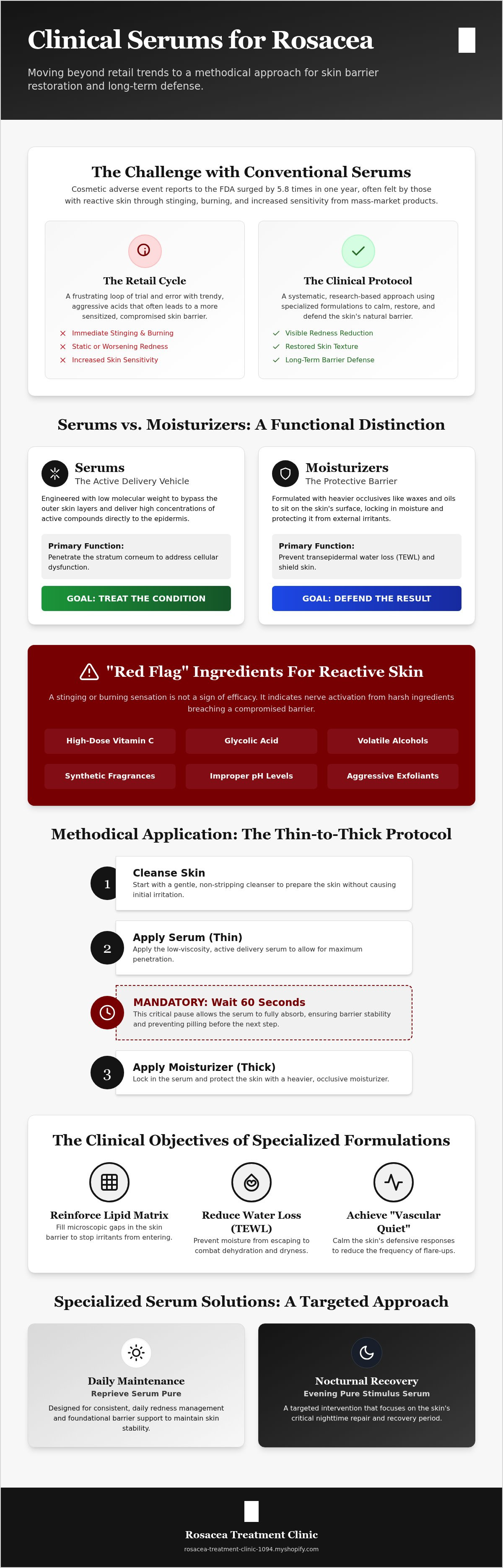
Denne artikkelen gir en klinisk analyse av forskjellen mellom massemarkedsformuleringer og forskningsbaserte topikale protokoller. Du lærer hvordan du identifiserer spesialiserte leveringssystemer utviklet for de unike behovene til en svekket hudbarriere. Vi undersøker den systematiske bruken av formuleringer som Reprieve Serum Pure og Evening Pure Stimulus Serum for å oppnå en synlig reduksjon av betennelse i ansiktet. Ved å gå bort fra reaktive detaljhandelsrutiner og over til en metodisk tilnærming kan du gjenopprette hudens tekstur og etablere en trygg og effektiv lagdelingsrekkefølge som prioriterer langsiktig beskyttelse og gjenoppbygging.
Viktigste poenger
- Forstå det tekniske skillet mellom leveringssystemer med høy styrke og standardkremer til utvortes bruk for å optimalisere ingrediensopptaket i svekket hud.
- Identifiser bestemte potensielle «røde flagg»-ingredienser i kommersielle serumer, som høydosert C-vitamin og glykolsyre, som ofte overskrider sviegrensen til reaktive hudbarrierer.
- Følg en presis lagdelingsprotokoll fra «tynt til tykt», inkludert en obligatorisk ventetid på 60 sekunder, for å sikre stabilitet i hudbarrieren og optimal produkteffekt.
- Lær om den kliniske nytten av spesialiserte formuleringer som Reprieve Serum Pure og Evening Pure Stimulus Serum for målrettet håndtering av rødhet og gjenoppbygging av huden.
Serumenes funksjonelle rolle i kliniske hudpleieprotokoller
I en profesjonell dermatologisk protokoll fungerer serum som transportmidler med høy konsentrasjon, utviklet for spesifikke kliniske resultater. Disse formuleringene skiller seg grunnleggende fra standardkremer gjennom tettheten av oppløste stoffer og bærersystemene. Mens tradisjonelle emulsjoner inneholder høye andeler voks og oljer for å gi overflateokklusjon, bruker et serum en struktur med lav molekylvekt. Dette gjør at aktive forbindelser mer effektivt kan passere de ytterste hudlagene. For pasienter som håndterer kroniske betennelsestilstander, er serumfasen det viktigste trinnet. Det er den primære metoden for å tilføre gjenoppbyggende stoffer til overhuden før påføring av tyngre beskyttende barrierer.
Serum kontra fuktighetskremer: En fysiologisk forskjell
Forskjellen mellom disse to produktkategoriene ligger i fasen for «aktiv levering» kontra fasen for «beskyttende barriere». Serum er utviklet for å trenge gjennom stratum corneum og nå dypere inn i hudens struktur for å behandle cellulær dysfunksjon. Fuktighetskremer fungerer derimot som kraftige okklusive midler som legger seg på overflaten for å hindre fordamping av fuktighet. For personer som har fått diagnosen rosacea, er dette påføringshierarkiet avgjørende. Å kun stole på en fuktighetskrem vil ofte ikke behandle den underliggende vaskulære hyperaktiviteten. Du må prioritere serumets kvalitet for å sikre at de betennelsesdempende virkestoffene faktisk absorberes, i stedet for bare å bli liggende i en overflatefilm. En velkomponert rutine bruker serumet til å behandle tilstanden og fuktighetskremen til å beskytte resultatet.
Det kliniske målet med betennelsesdempende topiske behandlinger
Et hovedmål med spesialiserte serum er en målbar reduksjon av transepidermalt vanntap (TEWL). Når hudbarrieren er svekket, gjør mikroskopiske åpninger at fuktighet slipper ut, samtidig som irritanter slipper inn. Denne syklusen fører til vedvarende stikking og brennende følelser som forbindes med reaktiv hud. Kliniske topiske behandlinger virker ved å nøytralisere miljøutløsere gjennom å styrke lipidmatrisen. De gir en systematisk tilnærming til å dempe hudens defensive responser. Ved å stabilisere barrieren reduserer disse protokollene hyppigheten av oppblussinger og hjelper huden med å opprettholde en tilstand av «vaskulær ro». Denne prosessen handler ikke om midlertidig lindring, men om langsiktig gjenoppretting av hudens naturlige forsvarsevne.
Daglig vedlikehold krever en annen tilnærming enn akutt reparasjon. Grunnleggende hjelpemidler som Reprieve Serum Pure er utviklet for konsekvent, daglig håndtering av rødhet og støtte til hudbarrieren. Disse skiller seg fra målrettede tiltak som Evening Pure Stimulus Serum , som fokuserer på hudens restitusjonsperiode om natten. Når du forstår den spesifikke nytten av hver væske, blir det mulig å følge en mer disiplinert og effektiv behandlingsplan. Ved å velge produkter basert på deres kliniske formål i stedet for kommersielle trender kan du bevege deg bort fra reaktive sykluser og mot en forutsigbar hudhelse.
Mekanismen bak høypotente serum: absorpsjon versus irritasjon
Ved en svekket hudbarriere følger opptaket av topiske stoffer en annen fysiologisk vei enn i friskt vev. Økt permeabilitet i overhuden gjør at serum trenger dypere inn og absorberes raskere. Selv om dette letter tilførselen av aktive forbindelser, øker det samtidig risikoen for nevrovaskulær irritasjon. Forskning fra Spectrum Analytical Laboratory understreker at høypotente formuleringer må utvikles med tanke på denne sårbarheten. Uten et kontrollert leveringssystem kan selv nyttige ingredienser bli utløsere for inflammatoriske kaskader. Presisjon i formuleringen sikrer at gjenopprettingsprosessen ikke utilsiktet fremskynder vaskulær hyperaktivitet.
Forstå svieresponsen
Den umiddelbare stikkende eller brennende følelsen som ofte oppleves med kommersielle produkter, er sjelden et «tegn på effekt». I stedet tyder den på aktivering av trigeminusnerven av flyktige alkoholer, syntetiske dufter eller feil pH-nivåer. Mange kommersielle serum er formulert med høy surhetsgrad for å stabilisere bestemte vitaminer, men denne lave pH-en overskrider ofte hudens toleranse. Dette skaper en syklus av mikroinflammasjon som ytterligere bryter ned lipidmatrisen. Terskelen for svie er en klinisk markør for svekket hudbarriere og representerer punktet der topiske påføringer utløser sensoriske nervefibre på grunn av overdreven permeabilitet i overhuden. Når et produkt ikke holder seg innenfor denne terskelen, bidrar det til langsiktig sensibilisering i stedet for reparasjon.
Biokompatible leveringssystemer
Forskningsbaserte protokoller bruker biomimetiske lipider som etterligner hudens naturlige molekylstruktur. Disse leveringssystemene gjør det mulig for aktive virkestoffer å integreres sømløst i det intercellulære sementet i stratum corneum. Ved å bruke en mekanisme for langsom frigjøring unngår disse formuleringene å overvelde reaktiv hud med en plutselig tilførsel av konsentrerte ingredienser. Denne metodiske tilnærmingen sikrer at fasen med «aktiv levering» forblir under irritasjonsterskelen. Det er avgjørende å opprettholde klinisk renhet for å hindre tilførsel av forurensende «aktive ingredienser» som ofte finnes i massemarkedsprodukter. For dem som stadig opplever ubehag med standardprodukter fra detaljhandelen, er det nødvendig å gå over til en spesialisert serumprotokoll for å stabilisere hudens defensive lag.
Betydningen av riktig pH-balanse kan ikke overvurderes i denne sammenhengen. En klinisk formulering respekterer hudens syrekappe, som vanligvis ligger mellom 4,5 og 5,5. Når serum avviker for mye fra dette området, forstyrrer de enzymene som er ansvarlige for lipidsyntesen. Denne forstyrrelsen stanser reparasjonsprosessen. Ved å prioritere fysiologisk kompatibilitet fremfor «trendy» høye syrekonsentrasjoner gir kliniske protokoller et forutsigbart miljø for hudens restitusjon. Dette fokuset på sikkerhet og hudstabilitet er det som skiller en forskningsbasert behandling fra et generisk detaljhandelsprodukt.
Slik skiller profesjonelle serum seg fra konvensjonelle detaljhandelsprodukter
Å evaluere serum krever et skifte fra markedsføringsdrevet utvelgelse til en disiplinert klinisk analyse av ingrediensene. Mange detaljhandelsprodukter prioriterer sanseopplevelsen eller prosentandeler av «helteingredienser» som overstiger den fysiologiske toleransen til en svekket hudbarriere. Et profesjonelt rammeverk fokuserer på formelens stabilitet og utelukkelse av cytotoksiske irritanter. Hovedmålet er å identifisere formuleringer som støtter hudens defensive struktur uten å utløse en nevrovaskulær respons. Ved å analysere den molekylære sammensetningen i stedet for merkevarens påstander om «beroligende» egenskaper, er det mulig å forutsi hvordan et produkt vil samhandle med en reaktiv hudbarriere.
Enkelte aktive ingredienser med høy styrke, som er vanlige i massemarkedet, fungerer som primære irritanter for reaktiv hud. Vitamin C i høy dose (L-askorbinsyre) og glykolsyre er betydelige «røde flagg»-ingredienser. Disse forbindelsene har ofte lav pH, noe som overskrider sviegrensen og fører til umiddelbar vasodilatasjon og vedvarende rødming. Profesjonelle protokoller bruker mer raffinerte alternativer som gir samme eller lignende fordeler uten den inflammatoriske kostnaden.
Det er viktig å skille mellom en påstand om «lindring», som kanskje bare gir midlertidig sensorisk lindring, og dokumentasjon på «barrierereparasjon», som innebærer en strukturell gjenoppbygging av lipidmatrisen.
Myten om «naturlig» sikkerhet i hudpleie
Antakelsen om at «naturlige» ingredienser i seg selv er tryggere, er en betydelig misforståelse innen dermatologisk behandling. Botaniske ekstrakter og eteriske oljer er komplekse kjemiske blandinger som ofte fungerer som potente allergener. For personer med rosacea kan disse stoffene utløse degranulering av mastceller og vedvarende rødhet. Klinisk inerte eller bioidentiske ingredienser foretrekkes generelt fordi de gir forutsigbare resultater uten risiko for et allergisk oppbluss.
Kliniske indikatorer på et serum av høy kvalitet
En formulering av høy kvalitet kjennetegnes av spesifikke desensibiliserende stoffer og fuktighetsgivende komplekser. Formuleringer fra Reprieve, som Reprieve Serum Pure , prioriterer umiddelbar nevrovaskulær ro for å bryte sviesyklusen. Disse kliniske væskene inneholder også virkelig stabile antioksidanter som beskytter mot UV-indusert oksidativt stress, en viktig drivkraft for inflammatorisk rødhet. Ved å fokusere på disse tekniske indikatorene sikrer du at produktet fyller en funksjonell rolle i behandlingsplanen din, i stedet for å fungere som et kosmetisk tillegg.
Kostnaden per bruk for kliniske serum overgår ofte kostnaden for butikkprodukter. Fordi disse formuleringene er svært konsentrerte og molekylært presise, gir en flaske på 30 mL langvarig behandling. Du trenger ikke store mengder for å oppnå en terapeutisk effekt. Investering i en spesialisert protokoll reduserer de økonomiske og fysiske kostnadene ved «prøving og feiling»-syklusen som forbindes med generiske butikkprodukter som ikke behandler den underliggende dysfunksjonen.
Metodisk påføring: Slik integrerer du serum i en rutine for reaktiv hud
Presisjon i påføringen er like viktig som selve formuleringen når man håndterer en reaktiv hudbarriere. En disiplinert fremgangsmåte sikrer at aktive forbindelser når målområdet uten å overbelaste hudens sensoriske nerver. Grunnprotokollen for lagvis påføring er regelen «tynt til tykt». Det innebærer at serum med lav viskositet skal påføres først, etterfulgt av emulsjoner og til slutt okklusive kremer. Denne rekkefølgen hindrer tyngre lipider i å danne en barriere som ellers ville blokkert absorpsjonen av mindre molekyler med høy styrke. For å sikre maksimal effekt kreves en obligatorisk ventetid på 60 sekunder mellom serum- og kremfasen. Denne pausen lar hudens pH stabilisere seg og sikrer at væsken er fullstendig integrert i hornlaget.
Beskyttelse på dagtid kontra reparasjon om natten
Hudens fysiologiske behov endres mellom morgen- og kveldssyklusen. Protokollene på dagtid fokuserer på beskyttelse mot miljøpåvirkninger og vaskulær stabilitet. Bruk av Reprieve Serum Pure på dagtid gir en kontinuerlig desensibiliserende effekt som bidrar til å håndtere svieresponsen som utløses av temperaturendringer eller stress. Nattens syklus er derimot viet til cellefornyelse og gjenoppbygging av hudbarrieren. Reprieve Night Serum Pure er utviklet for å støtte disse gjenopprettingsprosessene mens du sover. For dem som opplever vedvarende teksturproblemer, tilbyr Evening Pure Stimulus Serum en spesialisert behandling. Denne stimulansprotokollen fremmer sunn hudfunksjon uten den aggressive eksfolieringen som finnes i butikkprodukter. Ettersom mange aktive serum kan øke lysfølsomheten, er påføring av solkremer med høy og bred UVA-beskyttelse et ufravikelig siste trinn i enhver morgenrutine.
Rensingens betydning for serumets effekt
En vellykket behandlingssekvens begynner med en ren, mottakelig overflate . Bruken av en anti-inflammatorisk skummende rensegel eller desensibiliserende renseemulsjon er et viktig første skritt for å fjerne miljøforurensning og overflødig talg. Hvis et renseprodukt etterlater en hinne eller bruker sterke tensider, kan det enten hindre serumet i å trenge inn eller forårsake umiddelbar irritasjon som ingen etterfølgende produkt kan rette opp. Rester fra uegnede renseprodukter reagerer ofte dårlig med konsentrerte fluider, noe som fører til at produktet «nupper» eller gir lokalisert rødhet. En metodisk ramme for «Rens–Behandle–Beskytt» sikrer forutsigbare resultater:
- Rens: Bruk en pH-balansert, skånsom renseprodukt for å klargjøre hudbarrieren.
- Behandle: Påfør riktig kliniske serum.
- Beskytt: Forsegl behandlingen med en reparerende fluid eller krem om kvelden , eller fotobeskyttelse på dagtid .
Ved å følge denne strukturerte fremgangsmåten sørger du for at huden forblir i et kontrollert miljø. Når du fjerner usikkerheten fra den daglige rutinen, lar du de kliniske formuleringene utføre sin tiltenkte funksjon. For å begynne en systematisk tilnærming til hudhelse kan du se våre spesialiserte serumprotokoller utviklet for reaktive hudbarrierer.
Spesialiserte serumsløsninger: Rosacea Treatment Clinic-tilnærmingen
Rosacea Treatment Clinic, som ble etablert i 1996, bygger på et grunnlag av grundig forskning fra Spectrum Analytical Laboratory. Denne kliniske arven, som har røtter i grunnleggende studier fra midten av 1980-tallet, sikrer at hver formulering tar for seg den spesifikke etiologien bak inflammatoriske hudtilstander. I motsetning til generiske detaljhandelsprodukter inngår disse serumene i en systematisk, reseptfri tilnærming til dermatologisk helse. Fokuset er utelukkende på beskyttelse og gjenoppretting. Ved å bruke ingredienser med høy renhetsgrad gir disse protokollene et pålitelig alternativ til aggressiv bruk av detaljhandelsprodukter, som ofte forverrer barrieredysfunksjon.
Reprieve Serum Pure er det grunnleggende tiltaket for daglig håndtering av rødhet. Det stabiliserer den nevrovaskulære responsen for å forhindre den umiddelbare rødmen som forbindes med reaktive hudbarrierer. For dem som trenger en mer aktiv tilnærming til restitusjon, gir Evening Pure Stimulus Serum og Booster en kontrollert stimulering. Denne nattlige protokollen fremmer sunn epidermal funksjon uten risikoen for den aggressive eksfolieringen som finnes i massemarkedsprodukter. Den kliniske effekten forsterkes ytterligere gjennom samspillet mellom flere formuleringer. Antioxidant Radiance Defence Shield virker sammen med reparasjonsvæsker for å nøytralisere oksidativt stress. Denne kombinasjonen gir et omfattende skjold mot UV-utløst rødhet, samtidig som den gjenoppretter lipidmatrisen.
Målrettede protokoller for papulopustuløs og vaskulær rosacea
Vaskulær rosacea, som ofte kjennetegnes av vedvarende telangiektasier, krever serum som prioriterer vaskulær stabilitet og barietetthet. Disse formuleringene bidrar til å redusere synligheten av utvidede kapillærer ved å styrke den omkringliggende hudstrukturen. Hvis tilstanden viser seg med postinflammatorisk misfarging eller papulopustuløse symptomer, er den nye protokollen for harmonisering av hudtonen riktig behandling. Denne spesialiserte sekvensen retter seg mot ujevn pigmentering og tekstur, samtidig som den tar hensyn til den underliggende vevets ekstreme følsomhet. Valg av riktig protokoll avhenger helt av symptomens alvorlighetsgrad. En metodisk vurdering sikrer at behandlingen samsvarer med hudens nåværende toleransenivå, og forebygger «overbehandling» som fører til ytterligere betennelse.
Neste steg i din dermatologiske reise
Langsiktig hudstabilitet krever en overgang fra enkeltprodukter til omfattende, forskningsbaserte systemer. Disse systemene sikrer at hvert trinn, fra den innledende rensingen til den avsluttende påføringen av høy, utvidet UVA-beskyttelse, arbeider mot ett samlet klinisk mål. Ved å bruke reseptfrie, forskningsbaserte pleieprodukter blir det mulig å oppnå en forutsigbar bedringsprosess. Denne systematiske tilnærmingen eliminerer variablene som fører til oppblussinger, og gir huden et kontrollert miljø for tilheling. For å begynne overgangen til en profesjonell protokoll kan du utforske vårt spesialiserte utvalg av forskningsbaserte serum for å finne riktig behandling for din spesifikke hudprofil.
Oppnå langsiktig vaskulær stabilitet gjennom kliniske protokoller
Å gå fra en syklus med reaktive detaljkjøp til en disiplinert behandlingssekvens er den mest effektive måten å håndtere kronisk betennelse i ansiktet på. Ved å prioritere serum med høy renhetsgrad og uten resept fremfor trendy, men aggressive detaljhandelsformuleringer, legger du til rette for gjenoppbygging av hudens strukturelle barriere i stedet for midlertidig lindring på overflaten. Våre kliniske protokoller, etablert i 1996, bygger på grunnleggende forskning fra Spectrum Analytical Laboratory for å gi behandlinger som holder seg under sviegrensen for svekket hud.
En systematisk «Rens–Behandle–Beskytt»-tilnærming sikrer at aktive ingredienser tilføres trygt og effektivt. Det er en metodisk prosess som erstatter uforutsigbar prøving og feiling med vitenskapelig grundighet. For å starte din profesjonelle vei mot bedring kan du se vår komplette samling av spesialiserte kliniske serum. En rolig og motstandsdyktig hud er et realistisk resultat når du tilpasser den daglige rutinen til dokumenterte dermatologiske prinsipper. Du trenger ikke å håndtere sensitiv hud uten en pålitelig, forskningsbasert veiledning.
Ofte stilte spørsmål
Hvorfor svir det i ansiktet når jeg påfører de fleste serum?
Svie er en klinisk markør på svekket hudbarriere. Det indikerer at formuleringens pH-verdi eller flyktige ingredienser, som syntetiske duftstoffer og alkoholer, har trengt gjennom hornlaget og utløst trigeminusnerven. Konvensjonelle serum prioriterer ofte sensorisk appell fremfor fysiologisk kompatibilitet, noe som fører til denne umiddelbare nevrovaskulære responsen.
Kan jeg bruke et vitamin C-serum hvis jeg har rosacea?
Standardvitamin C i form av L-askorbinsyre er generelt kontraindisert for reaktiv hud på grunn av den høye surhetsgraden. Disse formuleringene har ofte en så lav pH-verdi at de kan utløse vasodilatasjon og vedvarende rødming. Profesjonelle protokoller foretrekker stabile antioksidantalternativer som gir beskyttende fordeler uten å overskride sviegrensen.
Hvor lang tid tar det før jeg ser resultater fra et serum som reparerer hudbarrieren?
Strukturell gjenoppbygging følger vanligvis hudens naturlige 28-dagers syklus for fornyelse av overhuden. Selv om spesialiserte væsker som Reprieve Serum Pure, Night Serum Pure og Hydrating Serum kan gi umiddelbar nevrovaskulær ro, krever målbare forbedringer i hudens tekstur og reduksjon av rødhet regelmessig påføring over flere uker. Denne tidsrammen gjør at lipidmatrisen effektivt kan integrere de gjenoppbyggende forbindelsene.
Trenger jeg å bruke en fuktighetskrem over serumet?
Ja, påføring av en fuktighetskrem eller fotobeskyttelse er et obligatorisk trinn for å gi okklusjon på hudoverflaten. Mens serum fungerer som transportmidler for aktive ingredienser, forsegler en krem som Night Repair Cream disse ingrediensene i huden. Denne rekkefølgen forhindrer transepidermalt vanntap og beskytter hudbarrieren mot miljøutløsere.
Hva er forskjellen mellom et serum og en reparerende behandlingsvæske?
Den viktigste forskjellen ligger i molekylvekt og lipidtetthet. Et serum er en lett, høypotent væske utviklet for dyp penetrasjon av aktive forbindelser. En reparerende behandlingsvæske, som Original Repair Treatment Fluid, har en mer omfattende lipidprofil som styrker hudens beskyttende mantel samtidig som den tilfører gjenoppbyggende egenskaper.
Er serumene trygge å bruke sammen med reseptbelagte behandlinger?
Våre reseptfrie, forskningsbaserte formuleringer er utviklet for høy renhet og sikkerhet. De er generelt kompatible med medisinske protokoller med fokus på håndtering av betennelse. Det anbefales at du rådfører deg med legen som har skrevet ut behandlingen, for å sikre at den spesifikke rekkefølgen for påføring av de ulike produktene er i samsvar med dine kliniske behov.
Hvor mange serum kan jeg legge i lag samtidig når jeg har sensitiv hud?
Begrens påføringen til én til tre spesialiserte formuleringer.
Hvorfor er høy UVA-beskyttelse nødvendig ved bruk av serum?
UVA-stråling er en viktig årsak til oksidativt stress og vaskulær hyperreaktivitet. Solkremer med høy og bred UVA-beskyttelse er avgjørende fordi de beskytter huden mot ytterligere nedbrytning mens behandlingsprotokollen din arbeider med å reparere hudbarrieren. Uten denne beskyttelsen kan miljøpåvirkning nøytralisere de gjenoppbyggende effektene av dine kliniske topiske behandlinger.