
Most standard skincare products marketed for sensitivity fail rosacea patients because they lack the technical precision required to address a compromised dermal barrier. If you have experienced the stinging, burning, and persistent erythema typical of reactive skin, you know that "gentle" is rarely sufficient. Implementing a complete rosacea skincare regimen requires more than just avoiding common irritants. It demands a methodical, minimum 5-piece protocol that targets the biological roots of chronic inflammation and stabilizes the skin's defense mechanisms with surgical precision.
It is exhausting to navigate the confusion of product application orders while managing persistent facial redness. You have likely found that even high-end formulations can trigger reactivity if they are not part of a structured, clinical system. This article provides the dermatological framework for a 5-piece rosacea regimen designed to reduce flare-up frequency and restore skin health. We'll examine the specific roles of anti-inflammatory cleansing, specialized repair treatments, and high-level UVA protection in a repeatable daily protocol for 2026. This systematic approach ensures your skin remains calm, less reactive, and professionally supported.
Key Takeaways
- Understand the dermatological framework of a complete rosacea skincare regimen designed to stabilize the skin barrier and mitigate chronic inflammatory responses.
- Identify the clinical necessity of non-disruptive cleansing using formulations like the Anti-Inflammatory Foaming Cleanser to preserve the acid mantle during active flares.
- Learn how to integrate specialized interventions such as Reprieve Serum Pure to address vascular reactivity and facilitate dermal reconstruction.
- Recognize why standard sunscreens often fail and the mandatory role of High Extended UVA Protection in preventing thermal triggers and UV-induced erythema.
- Establish a methodical 24-hour protocol that balances morning stabilization with evening repair for measurable clinical milestones at weeks 4 and 12.
The Clinical Logic of a 5-Piece Rosacea Skincare Regimen
A clinical regimen is a modular sequence of interventions designed to address the dual pathologies of chronic inflammation and barrier dysfunction. Unlike fragmented beauty routines, a complete rosacea skincare regimen prioritizes biological stability over immediate aesthetic gratification. This protocol reflects decades of research conducted by Spectrum Analytical Laboratory since the mid-1980s. Their findings demonstrate that effective management requires a proactive, 24-hour defensive system rather than reactive spot-treating of visible lesions. By transitioning to a structured protocol, you move from managing symptoms to stabilizing the underlying dermal environment.
The Core Components of a Specialized Protocol
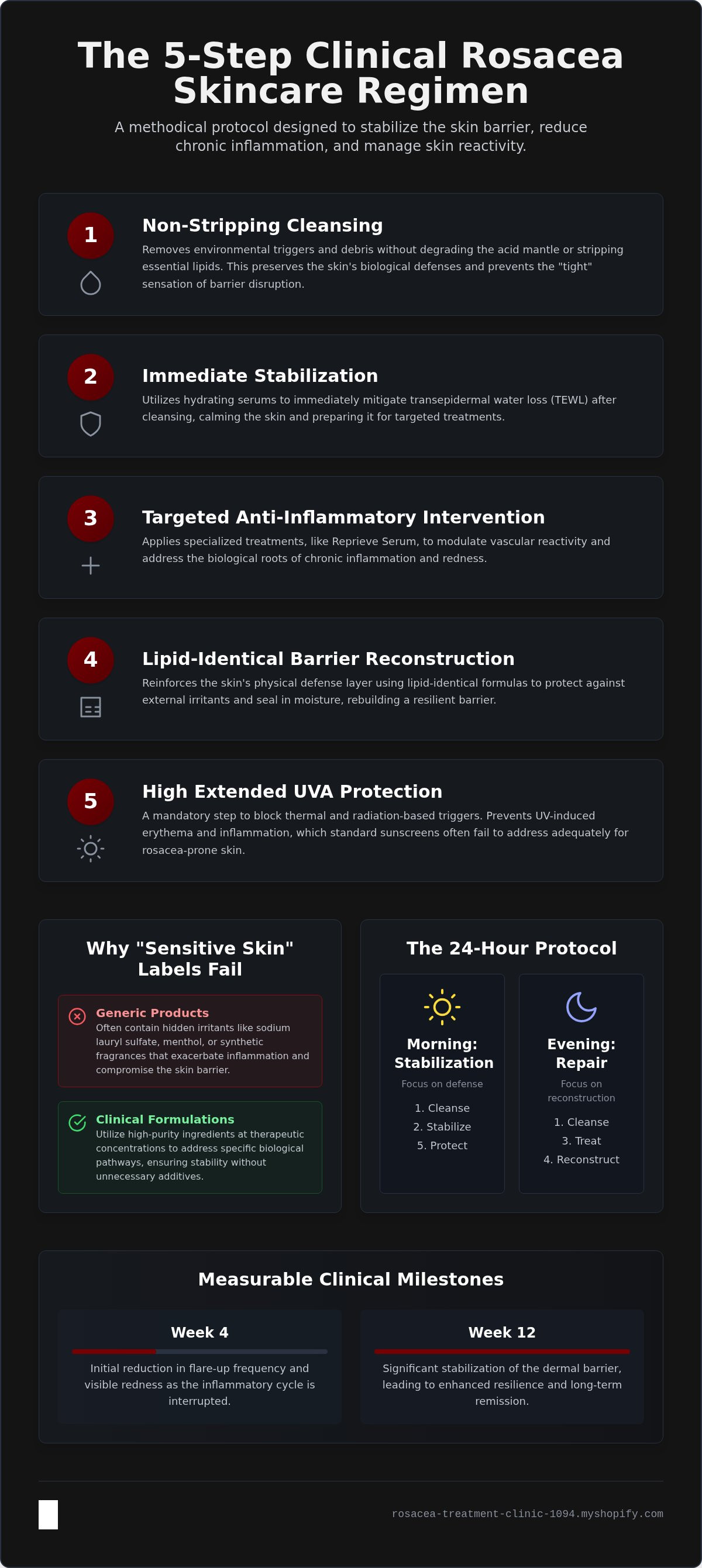
Effective management follows a specific hierarchy of care where each step reinforces the next. The 5-piece protocol is categorized into functional stages:
- Step 1: Non-stripping cleansing to remove environmental triggers and debris without degrading the acid mantle.
- Step 2: Targeted anti-inflammatory intervention to modulate vascular reactivity.
- Step 3: Stabilization through hydrating serum to mitigate transepidermal water loss.
- Step 4 (Evenings): Lipid-identical barrier reconstruction to reinforce the physical defense layer against external irritants.
- Step 5: High Extended UVA protection to block thermal and radiation-based triggers.
This systematic approach ensures that no single product is overworked. Each component serves a technical purpose within the broader defensive framework.
Why 'Sensitive Skin' Labels Aren't Enough
Generic "sensitive skin" marketing often ignores the specific pathology of Rosacea. Standard products frequently contain hidden irritants like sodium lauryl sulfate, menthol, or synthetic fragrances that exacerbate papulopustular rosacea. Dermatological formulations are essential because they utilize high-purity ingredients at therapeutic concentrations without the irritants common in retail skincare.
While the FDA approved new oral medications like Emrosi in late 2024 for inflammatory lesions, topical management remains the foundational requirement for long-term remission.
A complete rosacea skincare regimen ensures every biological pathway, from microbiome balance to vascular health, is addressed simultaneously.
This level of precision is necessary to move the skin from a state of hyper-reactivity to one of resilient health.
Step 1 & 2: Cleansing and Stabilization Foundations
The foundation of a complete rosacea skincare regimen begins with the preservation of the acid mantle. According to the National Institute of Arthritis and Musculoskeletal and Skin Diseases, Rosacea requires meticulous care to avoid exacerbating vascular sensitivity. Standard soaps and high-pH detergents strip essential lipids, leading to a "tight" sensation that signals barrier disruption. Dermatological cleansing aims to remove environmental pollutants, microbial overgrowth, and debris while leaving the skin's biological defenses intact. This is the first mandate of any professional protocol.
Selecting the appropriate agent depends on the current state of the skin. For those experiencing active papules or pustules, the Anti-Inflammatory Foaming Cleanser provides a thorough yet non-disruptive wash that targets inflammatory markers. Conversely, when extreme dryness or desquamation is the primary concern, the Hydrating Desensitising Cleansing Emulsion offers a lipid-rich alternative that replenishes the surface during the cleansing process.
Both formulations prioritize the structural integrity of the skin over aggressive degreasing.
Cleansing Protocol for Reactive Skin
Mechanical friction is a primary trigger for neurogenic inflammation. Patients should apply cleansing agents using light, circular motions with the fingertips, avoiding washcloths or abrasive brushes. Rinsing must be performed with lukewarm water, as thermal extremes induce vasodilation and flushing. The science of anti-inflammatory surfactants involves utilizing large-molecule cleansing agents that cannot penetrate the skin barrier, reducing the risk of irritation. pH-balanced cleansing maintains the integrity of the stratum corneum to prevent transepidermal water loss.
Introduction to Hydrating Stabilization
Cleansing, even when performed with clinical precision, temporarily leaves the skin vulnerable. The stabilization phase must occur within sixty seconds of towel-patting the face or the application of Reprieve Serum Pure or Night Serum Pure. Applying the Hydrating Serum captures moisture and conditions the dermal layers for active interventions. This step is a non-negotiable prerequisite for barrier repair because dehydrated cells cannot effectively utilize the complex lipids found in later stages of the protocol. Without this foundational hydration the skin remains in a state of high reactivity hindering the efficacy of the complete rosacea skincare regimen. You can view the specialized cleansing and hydration modules to determine which formulation suits your current skin profile.
Step 3 & 4: Active Serums and Barrier Reconstruction
Steps 3 and 4 represent the corrective core of a complete rosacea skincare regimen. While cleansing and stabilization establish a neutral baseline, these stages deliver the concentrated interventions necessary to modulate vascular reactivity and repair structural damage. The clinical efficacy of this protocol relies on the synergy between aqueous delivery systems and lipid-rich occlusives. It's this specific layering that ensures active compounds penetrate the epidermis before they're sealed into the dermal matrix by a secondary protective layer.
Step 3 utilizes the Reprieve Night Serum Pure, a clinical standard designed to address the neurogenic aspects of facial redness. It is formulated to reduce the sensitivity of the cutaneous nervous system to external triggers. This aqueous formulation allows for rapid absorption without the risk of occlusion-induced heat trapping, which often occurs when heavy creams are applied to already inflamed skin. Following this with Step 4 (Evening Repair or High Extended UVA Protection for daytime) provides the essential lipid-identical ingredients required to prevent environmental irritants from penetrating the compromised barrier. Without this dual-stage approach active ingredients often fail to reach the depth required for meaningful change.
Selecting the Correct Treatment Serum
Serum selection depends on the circadian requirements of the skin. During the day, the focus remains on environmental defense and the mitigation of erythema and Reprieve Serum Pure is used. In contrast, the evening protocol prioritizes recovery. Utilizing Reprieve Night Serum Pure facilitates overnight restoration when natural repair processes are most active. Addressing persistent stinging and heat requires anti-inflammatory serums that contain high-purity antioxidants. These compounds neutralize oxidative stress, providing a critical layer of defense against UV-induced inflammation and atmospheric pollutants.
The Mechanics of Barrier Reconstruction
The choice between the Original Repair Treatment Fluid and the Original Repair Treatment Cream is determined by the skin's specific lipid requirements. Understanding the serum vs cream functional hierarchy is vital; fluids offer a lighter profile for oily-reactive types, while creams provide the intensive emolliency needed for severely dry profiles. Both formulations utilize lipid-identical ingredients that mimic the skin's natural protective layer, effectively patching gaps in the stratum corneum. For cases of severe barrier compromise or post-flare desquamation, the Intense Night Nurturing Complex provides a highly concentrated restorative environment. This methodical layering ensures the skin doesn't remain vulnerable to the triggers that typically drive rosacea progression.
Step 5: High Extended UVA Protection as a Clinical Mandate
Standard sunscreens often fail patients because they prioritize UVB protection while neglecting the deeper, more destructive impact of UVA radiation. For a complete rosacea skincare regimen, simple broad-spectrum labeling is insufficient. Clinical success requires High Extended UVA Protection to mitigate the thermal triggers that drive vascular expansion. Many commercial SPF formulations utilize filters that absorb UV radiation into the skin and convert it into heat. This thermal byproduct can trigger immediate flushing and stinging in reactive skin. In contrast, clinical-grade barriers like the De-Sensitizing Barrier Fluid SPF 50 utilize specialized configurations to shield from radiiation without increasing the skin's surface temperature.
Clinical formulation requirements for rosacea-safe protection include:
- High Extended UVA ratings: These are necessary to block 320 to 400 nm wavelengths that standard filters miss.
- Anti-inflammatory delivery systems: Formulations must not cause reactive heating cycles.
- Layering compatibility: The fluid must sit over serums without destabilizing the underlying barrier.
UVA vs. UVB: The Rosacea Trigger
UVB rays cause superficial burning, but UVA radiation penetrates the deeper dermal layers where the vascular structures reside. This deep penetration aggravates the neurovascular system, leading to persistent erythema and the degradation of collagen. We view photo-protection as an active treatment phase in the 5-piece protocol rather than a secondary addition. UVA protection is the most critical step for preventing long-term skin thickening and the progression of permanent vascular damage. By maintaining a strict defensive layer you limit the cumulative radiation damage that characterizes chronic rosacea progression. This is why the UVA protection guide is essential for understanding how to block the specific wavelengths that traditional sunscreens often ignore.
Application and Re-application for Sensitive Skin
Integrating Attend SPF 50 into the morning protocol requires a methodical technique to avoid disrupting the underlying repair fluids. Patients should apply the sunscreen using a gentle "stipple, smooth and pat" method rather than vigorous rubbing. For those managing ocular rosacea, utilizing specialized eye-safe sunscreens is mandatory to prevent chemical migration into the conjunctiva, which causes significant stinging. Consistent re-application every two hours during peak exposure is necessary to maintain the integrity of the complete rosacea skincare regimen. This final step seals the previous four interventions, ensuring the skin remains in a controlled, protected environment throughout the day. You can explore our range of clinical UVA protection modules to finalize your defensive protocol.
Implementing the 5-Piece Protocol: Consistency and Results
Adopting a complete rosacea skincare regimen is a commitment to dermal physiological stability. Clinical success depends on the strict adherence to a 24-hour cycle that balances morning stabilization with evening repair. Adhering to a singular, research-based protocol prevents the chemical interference often caused by mixing disparate brands with incompatible pH levels or surfactant systems. When the skin is treated as a modular biological system, progress follows a predictable clinical timeline.
Expected clinical milestones occur in distinct phases:
- Week 1: A measurable reduction in neurogenic sensitivity, characterized by less stinging and immediate post-cleansing heat.
- Week 4: Visible improvement in the stratum corneum's texture and a decrease in the intensity of transient erythema.
- Week 12: Stabilization of vascular reactivity and a significant reduction in the frequency of inflammatory lesions.
Periodic interventions supplement the daily protocol to maintain long-term results. For instance, utilizing the Reprieve Mask after environmental exposure provides an intensive anti-inflammatory surge. During periods of increased cellular turnover, the Refining Foam can be introduced to manage texture without the mechanical friction of traditional exfoliants.
The Essential Morning Protocol (AM)
The morning sequence focuses on environmental defense and hydration. After Step 1 (Cleansing) and Step 2 (Reprieve Serum Pure and Hydrating Serum), the application of Step 5 (High Extended UVA Protection ) is mandatory. This creates a refractive shield against the radiation triggers discussed in previous sections. For those in urban environments, integrating the optional Antioxidant Radiance Defence Shield enhances the skin's capacity to neutralize atmospheric pollutants and HEV light. This preparation ensures the barrier remains resilient against the day's oxidative stressors.
The Evening Protocol (PM) with Retinisation
The PM protocol prioritizes cellular recovery and barrier fortification. Following Step 1, Step 3 (Reprieve Night Serum Pure and Evening Pure Stimulus Serum) delivers concentrated active agents when the skin's natural repair mechanisms are most receptive. Step 4 (Night Repair Cream) then provides the lipid-identical ingredients necessary for overnight reconstruction. If you experience unexpected rosacea flare-ups, the protocol should be simplified to foundational cleansing and intensive hydration until the acute inflammation subsides. This methodical approach ensures your complete rosacea skincare regimen remains responsive to your skin's fluctuating biological needs.
Achieving Sustained Dermal Resilience
Transitioning from fragmented, reactive care to a proactive 5-piece protocol is essential for managing chronic erythema and barrier reactivity. This systematic approach ensures that every biological pathway, from vascular sensitivity to lipid depletion, receives targeted support. By prioritizing High Extended UVA protection and lipid-identical reconstruction, you establish a defensive environment that minimizes the frequency of inflammatory flares. Adhering to a complete rosacea skincare regimen allows the skin to move beyond temporary relief and toward long-term physiological stability.
The Rosacea Treatment Clinic has provided specialized dermatological support since 1996. Our methodology is grounded in clinical research conducted by Spectrum Analytical Laboratory, focusing on the precise needs of compromised dermal barriers. Every component of our protocol is designed to work in synergy, ensuring efficacy without the risk of cross-product interference. Your journey toward calmer, less reactive skin begins with a commitment to a methodical, research-based system.
Explore the Research-Based Protocols at the Rosacea Treatment Clinic to begin your professional-grade skin stabilization protocol today.
Frequently Asked Questions
How do I know if a 5-piece regimen is right for my type of rosacea?
A 5-piece protocol is indicated for all subtypes because it addresses the foundational pathologies of barrier dysfunction and inflammation. Whether managing erythematotelangiectatic or papulopustular rosacea, the focus on lipid-identical reconstruction and vascular stabilization is universal. The system is modular; for instance, the Anti-Inflammatory Foaming Cleanser is selected for active flares, while the emulsion is used for dry-reactive states. This ensures the regimen remains responsive to individual clinical symptoms and fluctuating skin needs.
Can I mix products from different brands with this protocol?
Mixing brands is discouraged because it introduces chemical interference and pH fluctuations that can destabilize reactive skin. A complete rosacea skincare regimen is designed as a singular, research-based system where each surfactant and active agent is tested for synergy. Combining disparate products often leads to ingredient overlap, where multiple irritants or incompatible preservatives cause neurogenic inflammation and stinging. Sticking to one protocol ensures maximum efficacy and minimizes the risk of adverse reactions.
What is the correct order of application for a rosacea skincare kit?
The clinical sequence follows a specific hierarchy of care to ensure optimal absorption and barrier defense. Begin with Step 1: Cleansing, followed by Step 2: applying active serums like Reprieve Serum Pure to address vascular reactivity. Step 3: application of Hydrating Serum to capture moisture. Step 4 (evenings only) requires sealing these actives with lipid-identical Evening Repair. Finally, Step 5 (mornings only) is the application of High Extended UVA Protection to shield the dermal layers from radiation triggers.
Will a 5-piece regimen help with ocular rosacea symptoms?
Yes, though it requires specific ocular-safe modules to address the delicate eyelid environment. While the core facial protocol stabilizes the surrounding skin, patients should integrate the Ocular Conditioning Cleanser and Ocular Soothing Serum for direct eyelid care. These specialized formulations address the inflammation of the meibomian glands without the irritation common in standard facial products. Stabilizing the facial barrier also reduces the likelihood of migratory inflammation affecting the eye area.
How long does it take to see a reduction in redness with a clinical regimen?
Initial reduction in neurogenic stinging and heat typically occurs within the first week of protocol adherence. Visible improvement in persistent erythema and skin texture generally requires four weeks of consistency as the stratum corneum stabilizes. Significant clinical milestones, such as a reduction in vascular reactivity and inflammatory lesions, are usually documented after twelve weeks of maintaining the complete rosacea skincare regimen. Results depend on strict daily adherence to the 24-hour cycle.
Can I use retinoids like the Evening Pure Stimulus Serum if my skin is very reactive?
Yes, provided they are introduced during a stable phase of the protocol. The Evening Pure Stimulus Serum is formulated for reactive skin to support cellular turnover without the aggressive irritation of traditional retinoids. It is applied during the PM protocol. This controlled introduction helps thicken the epidermis over time, which ultimately reduces the appearance of visible redness and improves overall skin resilience. For further information see Clinical Guide to Evening Pure Stimulus Serum and Barrier Repair Protocols.
Is it necessary to use a cleanser twice a day for rosacea?
Twice-daily cleansing is mandatory to remove accumulated environmental pollutants, microbial overgrowth, and residual products. Morning cleansing removes overnight metabolic byproducts, while evening cleansing targets atmospheric debris and UV filters. Utilizing a non-stripping agent like the Anti-Inflammatory Foaming Cleanser ensures that this frequency does not compromise the acid mantle or induce transepidermal water loss. Regular cleansing prevents the buildup of triggers that can lead to acute inflammatory flare-ups.
Why is UVA protection more important than UVB for rosacea patients?
UVA radiation penetrates deeper into the dermis than UVB, directly aggravating the vascular and nervous systems. These longer wavelengths trigger the release of inflammatory mediators and degrade collagen, which leads to permanent skin thickening and visible blood vessels. While UVB causes superficial burning, UVA is the primary driver of chronic disease progression. This necessitates a High Extended UVA Protection formulation to block the full radiation spectrum effectively and prevent thermal triggers.