
The habitual preference for a deep-cleansing foaming lather might be the primary catalyst for your persistent facial erythema. While the sensation of "squeaky clean" skin is often marketed as a dermatological goal, for a reactive complexion, it frequently signals the destruction of the acid mantle. You have likely encountered the immediate stinging and post-wash tightness that characterizes a compromised skin barrier. It is a clinical reality that many traditional surfactants exacerbate the very inflammation you are attempting to manage.
This analysis provides the clinical criteria for selecting between a foaming cleanser vs cleansing emulsion for rosacea. You will discover how to de-sensitize reactive tissue while preserving the vital lipid barrier necessary for long-term health. We will examine the specific applications for the Anti-Inflammatory Foaming Cleanser and the Hydrating Desensitising Cleansing Emulsion. This guide moves through the mechanical differences of each format, offering a methodical, expert-led approach to restoring a calm, non-reactive complexion. By understanding the functional chemistry of these protocols, you can transition from reactive damage control to a structured system of barrier restoration and specialized care.
Key Takeaways
- Identify the specific mechanisms by which traditional surfactants trigger neurovascular reactivity and compromise the skin's vital lipid barrier.
- Evaluate the clinical criteria for selecting a foaming cleanser vs cleansing emulsion for rosacea based on your current levels of skin reactivity and oil production.
- Master the "Dry Application" technique and the necessity of temperature-controlled cleansing to prevent vasodilation and post-wash stinging.
- Discover how lipid-mimetic ingredients in specialized emulsions provide mechanical desensitisation for highly reactive tissue.
- Establish a methodical, research-based protocol to restore the skin's defensive functions and achieve a calm, non-reactive complexion post-cleansing.
The Clinical Challenge of Cleansing Reactive Rosacea-Prone Skin
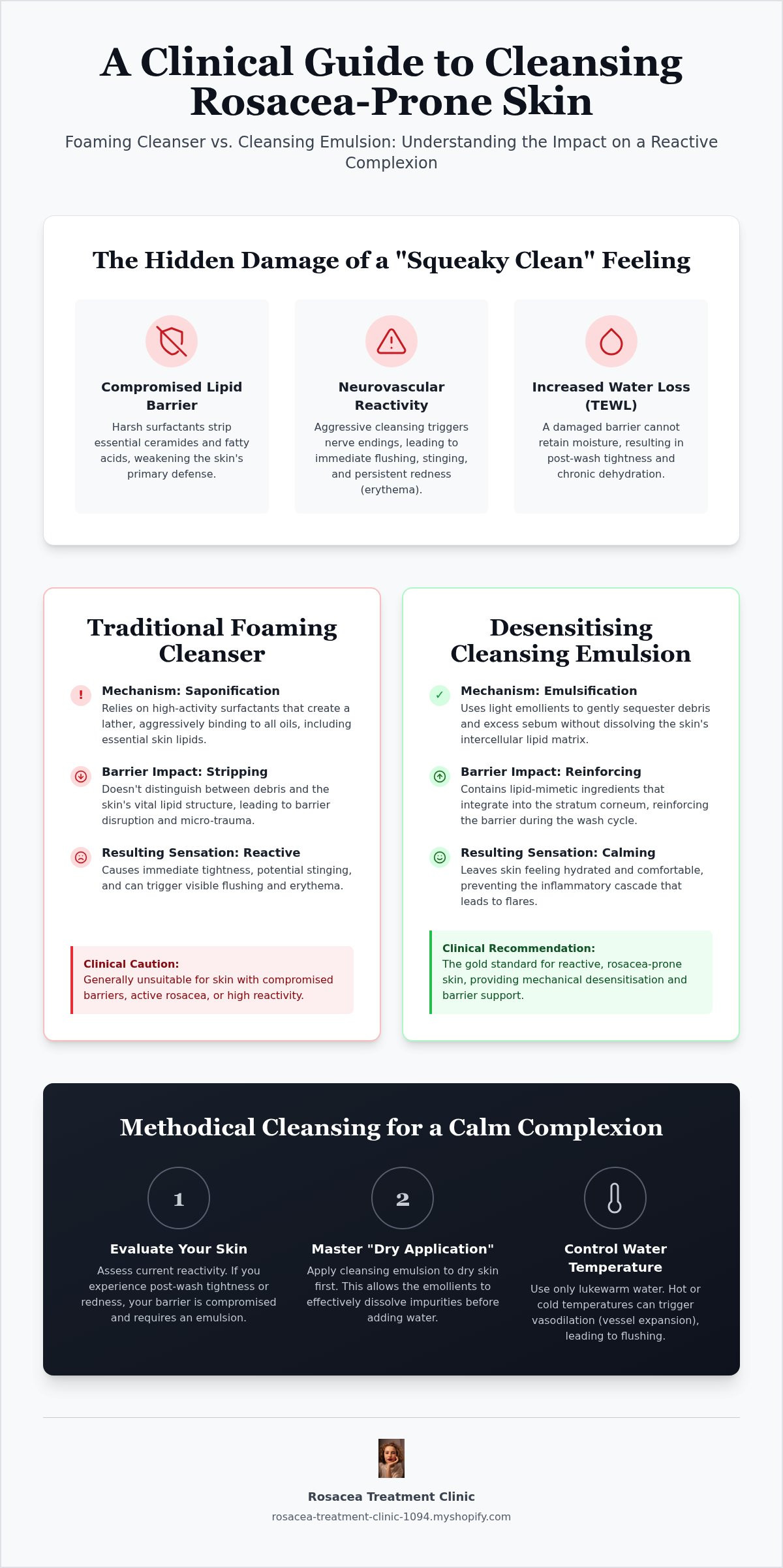
Clinical management of rosacea begins with the stabilization of the stratum corneum. In patients with reactive skin, the lipid barrier is inherently compromised. This state is often characterized by a deficiency in essential ceramides and fatty acids. Such structural weakness increases Transepidermal Water Loss (TEWL) and allows external irritants to reach deeper, more sensitive layers of the dermis. With a global prevalence as high as 10 percent, according to 2025 dermatological data, the need for specialized cleansing protocols is a clinical priority. The choice between a foaming cleanser vs cleansing emulsion for rosacea is not merely a matter of texture preference. It is a choice between chemical stripping and lipid preservation.
Traditional surfactants are designed to reduce surface tension and emulsify oils. However, many foaming agents do not distinguish between environmental debris and the vital lipids that hold skin cells together. During the wash cycle, these agents can cause immediate barrier disruption. This leads to a significant spike in TEWL, leaving the skin vulnerable to the "sting factor" immediately after rinsing. Transitioning from aggressive cleaning to protective emulsification is a clinical necessity for long-term stability. It is not just about what you remove, but what you leave behind.
Neurovascular Reactivity and the Cleansing Trigger
Improper cleansing protocols often serve as a primary trigger for neurovascular reactivity. When harsh surfactants contact a compromised barrier, they stimulate sensory nerve endings. This interaction releases inflammatory neuropeptides. The result is immediate facial flushing and persistent erythema. Maintaining the acid mantle's slightly acidic pH is critical. Standard soap-based products often have an alkaline pH. This further destabilizes the skin's defensive environment and promotes bacterial colonization. A specialized approach is required to cleanse without inciting a vascular response.
Identifying the Need for Mechanical Desensitisation
Recognizing the signs of barrier damage is essential for a methodical routine. If your skin feels tight or exhibits increased redness after washing, your current cleanser is likely causing micro-trauma. Surface cleanliness should not come at the expense of barrier integrity. When evaluating a foaming cleanser vs cleansing emulsion for rosacea, the presence of lipid-mimetic ingredients determines the level of mechanical desensitisation provided. By initiating hydration at the cleansing stage, you prevent the inflammatory cascade that leads to flares. This proactive approach ensures the skin remains calm and prepared for subsequent professional treatments.
Mechanical Analysis: How Desensitising Emulsion Restores the Lipid Barrier
Clinical data from the Spectrum Analytical Laboratory research, established in the mid-1980s, underscores the necessity of lipid preservation in reactive skin protocols. When comparing a foaming cleanser vs cleansing emulsion for rosacea, the mechanical action of the formula determines its impact on the dermal barrier. The Hydrating Desensitising Cleansing Emulsion operates through a sophisticated emulsification process rather than traditional saponification. This ensures that environmental debris and excess sebum are sequestered and removed without solubilizing the intercellular lipids that constitute the skin's primary defense. This methodical approach respects the delicate architectural integrity of the stratum corneum, which is frequently compromised in rosacea-prone patients.
The Emulsification Process vs. Saponification
Saponification relies on high-activity surfactants to create a lather. This process is often too aggressive for the compromised vascularity associated with rosacea. In contrast, non-foaming structures utilize light emollients to support the natural lipid shield. A desensitising emulsion is a barrier-protective topical solution that mimics the skin's natural oils. These lipid-mimetic components integrate into the stratum corneum during the wash cycle, reinforcing the barrier rather than stripping it. This methodical approach is essential for patients experiencing chronic erythema, as it prevents the chemical micro-trauma associated with high-lather surfactants. It is a clinical shift from aggressive degreasing to protective maintenance.
Clinical Benefits of Hydrating Lipid-Mimetic Components
The integration of humectants within an emulsion format prevents the immediate post-wash tightness that characterizes barrier disruption. By maintaining the skin's osmotic balance, these formulas ensure immediate moisture retention. This synergy between cleansing and hydration provides mechanical desensitisation, which directly reduces baseline redness. When the skin's protective layer is reinforced, neurovascular triggers are less likely to initiate an inflammatory response. Clinical observations indicate that patients using lipid-mimetic formulas report a significant reduction in burning and stinging sensations during the wash cycle.
This stability is the first step in a comprehensive rosacea protocol.
Implementing a specialized cleansing protocol allows for the methodical restoration of skin health. This shift from surface-level cleaning to deep barrier support is the foundation of modern rosacea management. By selecting formulations that respect physiological limits, clinicians can achieve a calm, non-reactive complexion. Transitioning to an emulsion format ensures that the skin remains hydrated and resilient, even in the presence of environmental stressors.
Comparative Evaluation: Foaming Cleanser vs. Cleansing Emulsion for Rosacea
Selecting between a foaming cleanser vs cleansing emulsion for rosacea requires a diagnostic assessment of your current skin phenotype. While emulsions are the clinical standard for barrier repair, certain phases of the condition benefit from the specific action of an Anti-Inflammatory Foaming Cleanser . The objective is to achieve high-efficacy removal of environmental pollutants and high-protection sunscreens without inciting a vascular flare. Modern "gel-to-milk" technologies facilitate this by using oil-based structures that emulsify upon contact with water. This provides the necessary slip to lift debris without aggressive mechanical friction.
Format Comparison Matrix for Rosacea Subtypes
The clinical utility of each format depends on the specific presentation of the disease. A methodical selection ensures that the cleansing step supports, rather than hinders, the overall treatment protocol:
- Anti-Inflammatory Foaming Cleanser: This format is optimal for oilier, less reactive phases or papulopustular rosacea. It effectively manages excess sebum and microbial load while incorporating soothing agents to mitigate irritation.
- Hydrating Desensitising Cleansing Emulsion: This is a critical protocol for acute sensitivity, dry skin types, and active barrier repair phases. It prioritizes lipid replacement over degreasing to stabilize the stratum corneum.
- Micellar Water: This format often fails the clinical test for rosacea. Residual surfactants left on the skin act as long-term irritants, triggering neurovascular responses hours after application.
Solubility and Residue Analysis
A clean rinse is a non-negotiable requirement for reactive skin. Any surfactant residue remaining on the stratum corneum serves as a pro-inflammatory stimulus. The Rosacea Treatment Clinic Hydrating De-Sensitizing Cleansing Emulsion is specifically engineered for high solubility, allowing it to be removed with minimal water contact and no abrasive toweling. This is particularly vital for ocular rosacea management, where the delicate eyelid margins require specialized care. Utilizing a dedicated Ocular Conditioning Cleanser can ensure that the meibomian glands are cleared without the risk of stinging or chemical blepharitis.
Efficacy in removing modern zinc-based sunscreens is another clinical benchmark. While emulsions excel at breaking down these dense mineral filters, the Anti-Inflammatory Foaming Cleanser may be utilized as a secondary step in a double-cleansing protocol for patients with high sebum production. Alternatively Pre-Cleansing Emulsifier can be used as the first step. This structured approach ensures the skin is cleared of all exogenous triggers before the application of restorative serums. It is a precise balance between thorough removal and barrier preservation.
Methodical Application: Integrating Emulsions into a Rosacea Protocol
Achieving therapeutic results requires more than just product selection. The mechanical delivery of the formula determines its desensitising potential. When analyzing the utility of a foaming cleanser vs cleansing emulsion for rosacea, the application method significantly impacts barrier recovery. For acute sensitivity, the "Dry Application" technique is the clinical standard. Applying an emulsion directly to dry skin allows the lipid-mimetic components to integrate more effectively with the stratum corneum before water dilution. This maximizes the protective shield and minimizes the risk of surfactant-induced stinging. During inflammatory flare-ups, this protocol should be strictly followed twice daily to stabilize the dermal environment.
Temperature control is a non-negotiable requirement. Hot water triggers immediate vasodilation, exacerbating facial flushing and neurovascular reactivity. Conversely, cold water can be too shocking for reactive vessels. Tepid water, ideally maintained between 25 and 30 degrees Celsius, ensures effective rinsing without inciting an inflammatory response. It is a methodical step that preserves the newly applied lipids on the skin surface. In maintenance phases, you might transition to an Anti-Inflammatory Foaming Cleanser for the evening wash, but the emulsion remains the foundational tool for morning desensitisation.
The Step-by-Step Clinical Cleansing Protocol
A structured protocol prevents microbial transfer and mechanical micro-trauma. Follow these steps to ensure barrier integrity:
- Preparation: Perform thorough hand hygiene to prevent the transfer of pathogens to the reactive skin surface.
- Application: Apply a generous amount of the Hydrating Desensitising Cleansing Emulsion to dry palms and distribute across the face.
- Massage: Use light, effleurage-style movements. Avoid circular friction or scrubbing as these actions trigger the release of inflammatory neuropeptides.
- Cleansing and Rinsing: Use a repetitive splashing motion with tepid water and massage gently. Do not use washcloths or abrasive sponges as these cause physical micro-abrasions.
Post-Cleansing Intervention
The window immediately following the wash cycle is critical for moisture retention. Apply the Hydrating Serum to lock in hydration and reinforce the osmotic balance. This sequence ensures the barrier is shielded before any environmental exposure. For a detailed analysis of this step refer to the Clinical Role of Hydrating Serum in Rosacea Management (2026). Consistent adherence to this sequence reduces baseline erythema and stabilizes the skin for more intensive treatments.
Establishing a predictable routine is essential for managing a reactive complexion. Explore the full range of specialized rosacea protocols to establish your methodical daily routine.
Research-Based Solutions: The Hydrating Desensitising Cleansing Emulsion
Specialized protocols for reactive skin are not the result of aesthetic trends. Instead, they are the clinical outcome of rigorous data analysis. The choice between a foaming cleanser vs cleansing emulsion for rosacea is ultimately determined by the need for barrier restoration. The Hydrating Desensitising Cleansing Emulsion was engineered to address the specific lipid deficiencies identified in Spectrum Analytical Laboratory research. This formulation prioritizes the replenishment of the intercellular matrix, moving the skin from a state of acute neurovascular reactivity to one of stable resilience. By reinforcing the stratum corneum, the emulsion provides a mechanical defense against the environmental triggers that typically incite a flare.
Clinical standards at the Rosacea Treatment Clinic dictate an absence of established allergens and irritants. These additives are common culprits in the "beauty industry cycle" of irritation. For a rosacea patient, even trace amounts of these substances can trigger a vascular response. By maintaining a pure profile the emulsion ensures that the cleansing process remains purely therapeutic. Long-term use results in a visibly calmer complexion and a significant reduction in post-wash stinging. It is a methodical transition from reactive damage control to a protected, healthy barrier.
Why a Research-Based Approach Matters
The Rosacea Treatment Clinic has maintained a specialized focus on rosacea pathology since its clinical focus was established in 1996. This legacy of expertise allows for the development of protocols that bypass temporary fixes in favour of structural repair. Many commercial products offer immediate cooling sensations that mask underlying inflammation without addressing the compromised lipid shield. A research-based approach focuses on the physiological causes of redness, such as high TEWL and barrier permeability. Non-prescription dermatological protocols demonstrate significant clinical efficacy in the long-term management of facial redness and barrier instability. This specialized knowledge ensures that every step of your routine contributes to dermal health.
Selecting Your Cleansing Protocol
Your skincare needs evolve as your skin's defensive functions improve. While the Hydrating Desensitising Cleansing Emulsion is the primary tool for acute sensitivity, you may eventually integrate other formats. Consulting the Cleansers Collection allows you to tailor your protocol based on your current phenotype. As your barrier becomes more resilient and baseline redness decreases, you might introduce the Anti-Inflammatory Foaming Cleanser for deeper cleansing during oilier phases. This methodical progression ensures that your skin is never over-processed. To begin your journey toward a calm and restored complexion, secure the Hydrating Desensitising Cleansing Emulsion as the foundation of your daily care.
Restoring Barrier Integrity Through Methodical Cleansing
The clinical selection between a foaming cleanser vs cleansing emulsion for rosacea determines the trajectory of your skin's recovery. Effective management requires a transition from aggressive surfactants to lipid-mimetic formulas that preserve the acid mantle. By prioritizing mechanical desensitisation you can mitigate the neurovascular triggers responsible for persistent erythema and post-wash stinging. This shift is essential for anyone experiencing the chronic tightness associated with a compromised dermal shield.
Our protocols are founded on mid-1980s Spectrum Analytical Laboratory research and specialized clinical focus established in 1996. These formulations are specifically engineered for the most reactive rosacea subtypes; they ensure that the cleansing cycle initiates restoration rather than damage. This methodical rigor ensures that your skin's defensive functions are rebuilt with surgical precision. A structured approach to daily hygiene is the functional prerequisite for all subsequent professional interventions.
It is possible to break the cycle of reactive inflammation and achieve long-term stability. Optimize your cleansing protocol with the Hydrating Desensitising Cleansing Emulsion to establish a resilient, protected barrier. Consistent adherence to these clinical standards will lead to a calm, predictable complexion.
Clinical Frequently Asked Questions
Is a cleansing emulsion effective for removing heavy makeup?
A cleansing emulsion is highly effective for removing heavy makeup and mineral sunscreens through the principle of "like dissolves like." The lipid-mimetic structure sequesters exogenous pigments and waxes without disrupting the skin's natural intercellular lipids. This process allows for thorough removal without the aggressive mechanical friction often required by foaming agents. For optimal results with heavy coverage perform an initial application of Pre-Cleansing Emulsifier before proceeding with Hydrating De-Sensitising Cleansing Emulsion .
Can I use the Hydrating Desensitising Cleansing Emulsion if I have oily skin?
Patients with oily but reactive skin benefit significantly from this formulation. Many oily rosacea phenotypes suffer from a compromised barrier that triggers compensatory sebum production. Utilizing the Hydrating De-Sensitising Cleansing Emulsion stabilizes the acid mantle and reduces this reactive oiliness. If your skin enters a less reactive phase with high sebum levels, you may transition to the Anti-Inflammatory Foaming Cleanser for the evening wash cycle to manage surface lipids more aggressively.
How long does it take to see a reduction in skin sensitivity?
Reductions in post-wash stinging and burning are typically reported immediately after the first application. However, the structural restoration of the lipid barrier is a methodical process that generally requires 14 to 28 days of consistent use. This timeline aligns with the natural cellular turnover rate of the stratum corneum. During this period the skin gradually transitions from a hyper-reactive state to a more resilient, calm complexion as the defensive functions are reinforced.
What happens if I use hot water with my cleansing emulsion?
Utilizing hot water induces immediate vasodilation which exacerbates facial flushing and persistent erythema. High temperatures also increase the solubility of the skin's essential lipids leading to their premature removal and further barrier degradation. This thermal stress triggers neurovascular responses that can negate the desensitising benefits of the emulsion. Tepid water, maintained between 25 and 30 degrees Celsius, is the clinical requirement for preserving the skin’s architectural integrity during the rinse cycle.
Is this emulsion safe for use around the eyes with ocular rosacea?
The formulation is engineered to clinical standards and is safe for the periocular area. Its fragrance-free and dye-free profile minimizes the risk of chemical blepharitis or stinging. While effective for general eye area hygiene, patients with severe ocular involvement should consider the Ocular Conditioning Cleanser for targeted management of the eyelid margins. This ensures the meibomian glands remain clear without inciting the inflammatory cascade common in reactive ocular rosacea subtypes.
Do I need a second cleanser after using a cleansing emulsion?
A secondary cleanser is unnecessary. The emulsion's high solubility ensures a clean rinse without problematic residue. In cases of high sebum production or water-resistant sunscreen use, and to reduce demodex, a double-cleansing protocol can be utilized. This involves an initial application of Pre-Cleansing Emulsifier followed by the Hydrating De-Sensitising Cleansing Emulsion .
Can this product be used alongside prescription rosacea treatments?
This emulsion serves as an ideal non-prescription support for various dermatological protocols. Many prescription interventions can cause secondary dryness or localized irritation. Integrating the Hydrating De-Sensitising Cleansing Emulsion helps mitigate these side effects by reinforcing the skin's defensive layer. While the product is formulated for high compatibility, patients should always consult their clinical specialist when integrating new topicals into a medically supervised routine to ensure optimal synergy between all treatment components.
Why is the dry application method recommended for emulsions?
The dry application method is recommended to maximize the contact time between the emulsion’s lipid-mimetic components and the skin's surface. Applying the product to dry skin allows the formula to effectively sequester environmental debris and makeup before it is diluted by water. This technique ensures superior mechanical desensitisation by allowing the protective ingredients to integrate with the stratum corneum.