
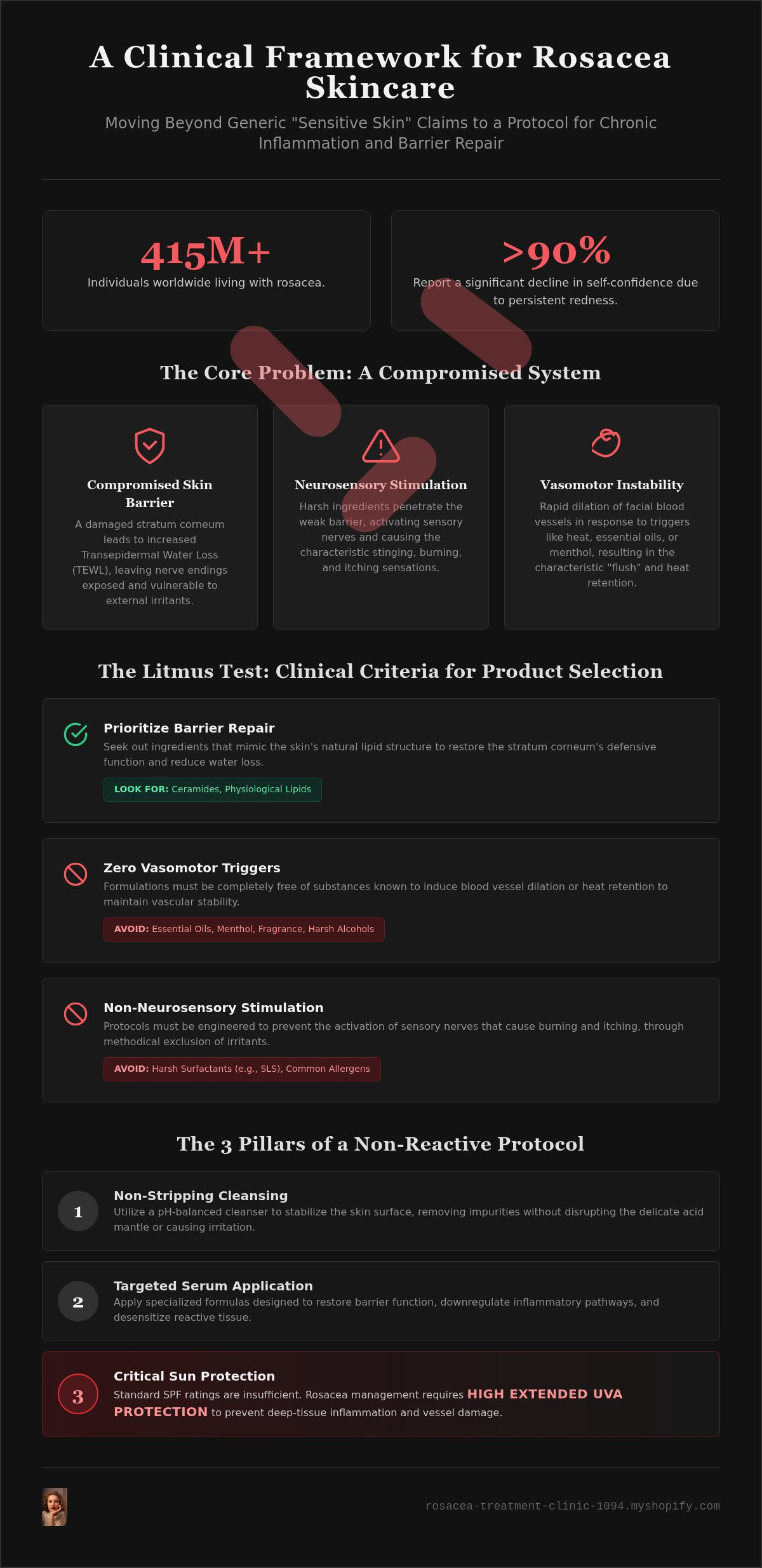
Plus de 90 % des 415 millions de personnes vivant avec une rosacée dans le monde signalent une baisse significative de leur confiance en soi en raison des rougeurs faciales persistantes. Pour beaucoup, la recherche de produits de soin pour la rosacée efficaces s'avère être un cycle répétitif d'essais et d'erreurs qui entraîne fréquemment des picotements, des sensations de brûlure ou une inflammation accrue.
Vous avez probablement découvert que les produits commercialisés comme « doux » ou « pour peaux sensibles » échouent souvent à prévenir les bouffées vasomotrices ou à protéger la barrière cutanée fragilisée.
La difficulté de trouver des écrans solaires qui n'irritent pas les yeux ne fait qu'ajouter à cette frustration clinique.
Cet article établit un cadre clinique pour sélectionner des protocoles de soin non irritants et appuyés par la recherche conçus pour stabiliser les tissus réactifs. Nous irons au-delà des allégations marketing génériques pour privilégier l'efficacité dermatologique et la restauration de la barrière cutanée. Vous apprendrez à identifier des formulations spécialisées qui inhibent les voies inflammatoires et à simplifier votre routine quotidienne en un système prévisible et non réactif. Nous examinerons les critères spécifiques pour sélectionner des écrans solaires à haute protection et des nettoyants anti-inflammatoires qui respectent les besoins uniques des peaux sujettes à la rosacée, garantissant que votre protocole est fondé sur une rigueur scientifique plutôt que sur les tendances de l'industrie.
Points clés
- Identifier la distinction clinique entre la sensibilité générique et l'état inflammatoire chronique de la rosacée pour mieux traiter la perte insensible en eau.
- Utiliser un cadre rigoureux pour sélectionner des produits de soin pour la rosacée qui excluent spécifiquement les déclencheurs vasomoteurs et les stimulants neurosensoriels comme les brûlures ou les démangeaisons.
- Établir un protocole fondamental impliquant un nettoyage non décapant et une application de sérum ciblée pour restaurer la fonction barrière et désensibiliser les tissus réactifs.
- Comprendre pourquoi les indices FPS standards sont insuffisants pour la gestion de la rosacée et pourquoi une haute protection UVA étendue est essentielle pour prévenir l'inflammation des tissus profonds.
- Explorer des interventions dermatologiques avancées, notamment l'intégration méthodique de rétinoïdes sans ordonnance et de protocoles d'harmonisation du teint pour traiter l'érythème post-inflammatoire.
Comprendre les besoins spécialisés des peaux sujettes à la rosacée
La rosacée représente bien plus qu'un état de sensibilité accrue. Il s'agit d'un trouble inflammatoire chronique et multifactoriel caractérisé par un érythème persistant et, ultérieurement, une télangiectasie. Alors qu'une peau sensible réagit généralement aux facteurs de stress externes, la rosacée implique un système immunitaire inné hyperactif. Les recherches indiquent que les individus souffrant de cette affection présentent souvent des niveaux élevés de cathélicidines ; ce sont des peptides antimicrobiens qui, lorsqu'ils sont mal traités, déclenchent des rougeurs faciales et une sensation de chaleur importantes. Comprendre la rosacée nécessite de reconnaître ce dysfonctionnement biologique sous-jacent plutôt que de le traiter comme une irritation superficielle temporaire.
L'un des principaux facteurs d'inconfort est une barrière cutanée compromise. Lorsque la couche cornée est endommagée, cela entraîne une augmentation de la perte insensible en eau (PIE). Cette déshydratation laisse les terminaisons nerveuses exposées et vulnérables. Les cosmétiques standards vendus dans le commerce aggravent souvent ce phénomène en contenant des tensioactifs agressifs ou des déclencheurs cachés qui induisent une instabilité vasomotrice. La sélection de **produits de soin pour la rosacée** spécialisés est donc une nécessité clinique pour restaurer l'intégrité de la barrière et prévenir l'inflammation chronique.
Sans une approche ciblée, la peau reste dans un état de réactivité perpétuelle.
Le mécanisme de la stimulation neurosensorielle
Les réponses neurosensorielles telles que les picotements et les démangeaisons ne sont pas de simples désagréments. Elles indiquent que la couche protectrice de la peau est défaillante.
Certains émulsifiants et conservateurs présents dans les produits de grande consommation pénètrent facilement une barrière endommagée, atteignant les couches épidermiques plus profondes où ils provoquent une réponse nerveuse sensorielle.
Le maintien d'un équilibre précis du pH est essentiel pour l'environnement des peaux sujettes à la rosacée.
Lorsqu'un produit a un pH trop élevé, il perturbe le manteau acide, augmentant ainsi la susceptibilité aux irritations.
L'utilisation d'un nettoyant moussant anti-inflammatoire au pH équilibré aide à stabiliser la surface de la peau sans induire ces déclencheurs neurosensoriels.
Instabilité vasomotrice et bouffées de chaleur faciales
L'instabilité vasomotrice fait référence à la dilatation rapide des vaisseaux sanguins du visage en réponse à des stimuli spécifiques. Ce processus physiologique aboutit au « flush » caractéristique associé à la maladie. De nombreux ingrédients « naturels », tels que les huiles essentielles ou le menthol, agissent comme de puissants déclencheurs de changements neurovasculaires. Ces substances peuvent provoquer une expansion immédiate des vaisseaux et une rétention de chaleur. Les protocoles cliniques doivent privilégier des ingrédients qui soutiennent la stabilité vasculaire et éviter ceux qui favorisent une dilatation indésirable. En vous concentrant sur des produits de soin pour la rosacée non réactifs et testés dermatologiquement, vous pouvez atténuer la fréquence et l'intensité de ces épisodes de bouffées de chaleur tout en soutenant la santé de votre peau à long terme.
Critères cliniques pour les produits de soin pour la rosacée
La sélection de produits de soin pour la rosacée nécessite une évaluation rigoureuse des profils d'ingrédients pour s'assurer qu'ils répondent à des critères cliniques spécifiques.
Contrairement aux formulations génériques pour peaux sensibles, les produits destinés à la rosacée doivent traiter l'état chronique d'hyper-réactivité neurovasculaire.
L'objectif principal est l'absence totale de déclencheurs vasomoteurs. Cela signifie que les formulations ne doivent pas être capables d'induire une dilatation des vaisseaux sanguins ou une rétention de chaleur.
L'efficacité clinique est définie par la capacité d'un produit à maintenir la stabilité vasculaire tout en supprimant activement les voies inflammatoires.
La non-stimulation neurosensorielle est un critère secondaire, mais tout aussi vital. Les protocoles efficaces sont conçus pour prévenir l'activation des nerfs sensoriels qui causent des brûlures et des démangeaisons. Cela implique une exclusion méthodique des allergènes et des irritants. Au-delà de la simple éviction, l'approche clinique privilégie le soutien de la barrière cutanée. Les produits haute performance utilisent des ingrédients qui imitent la structure lipidique naturelle de la peau, tels que des lipides physiologiques et des céramides. Ces composants s'intègrent dans la couche cornée endommagée pour restaurer sa fonction défensive et réduire la perte insensible en eau.
Une véritable efficacité anti-inflammatoire va au-delà du simple fait d'être « doux ». Elle nécessite des agents apaisants actifs capables de réguler à la baisse la réponse immunitaire innée. Vous devriez rechercher des protocoles ayant été systématiquement testés pour leur capacité à calmer les tissus réactifs et à réduire la base des rougeurs faciales. Pour ceux qui recherchent une approche structurée des soins, explorer des collections dermatologiques spécialisées fournit une base pour la santé cutanée à long terme.
Le rôle du nettoyage anti-inflammatoire
Les tensioactifs traditionnels, tels que le laurylsulfate de sodium, sont strictement contre-indiqués pour les patients atteints de rosacée en raison de leur capacité à éliminer les lipides essentiels et à perturber le manteau acide. Le rôle clinique du nettoyant moussant anti-inflammatoire dans la gestion quotidienne est d'éliminer les impuretés sans compromettre le bouclier biologique de la peau. Cette formulation spécifique équilibre une purification de surface efficace avec la préservation de la barrière épidermique. Elle garantit que la peau reste calme et préparée pour les étapes de traitement suivantes sans induire de réponse vasomotrice.
Sérums désensibilisants et hydratants
L'utilité d'un sérum hydratant réside dans sa capacité à réduire la réactivité cutanée grâce à un réapprovisionnement en humidité dans les tissus profonds. Des facteurs hydratants concentrés soutiennent la réparation de la barrière épidermique en fournissant l'environnement nécessaire à la restauration cellulaire. Ces sérums doivent être exempts d'irritants. En délivrant des humectants et des agents désensibilisants de haute pureté, ces formulations aident à abaisser le seuil de sensibilité de la peau et à améliorer la tolérance globale aux facteurs de stress environnementaux.
Composants essentiels d'un protocole de gestion de la rosacée
Un protocole de gestion de la rosacée réussi suit une séquence méthodique conçue pour minimiser les épisodes réactifs. C'est un processus en quatre étapes : stabiliser la surface, désensibiliser les couches épidermiques plus profondes, renforcer la barrière et prévenir les cascades inflammatoires induites par les UV. Cette approche structurée garantit que chacun des produits de soin pour la rosacée utilisés fonctionne en synergie pour restaurer la santé de la peau plutôt que de provoquer des réactions contradictoires. La cohérence dans l'ordre d'application est tout aussi cruciale que les ingrédients eux-mêmes.
La première étape consiste en un nettoyage non décapant pour éliminer les impuretés de surface tout en maintenant l'équilibre du pH. La deuxième étape utilise des sérums ciblés pour délivrer des agents désensibilisants concentrés. L'application vespérale de réparation de la barrière suit pour sceller l'hydratation et fournir un bouclier défensif et réparateur, tandis que le matin, l'utilisation d'écrans solaires à haute protection suit les sérums pour bloquer le rayonnement qui déclenche la dilatation vasculaire.
Adhérer à cette séquence clinique aide à faire passer la peau d'un état d'hyper-réactivité à une stabilité à long terme.
Stratégies de nettoyage : Mousse vs Émulsion
Le choix du nettoyant dépend de votre phénotype cutané spécifique. Bien que des agents moussants soigneusement sélectionnés soient efficaces pour tous les types de peau, vous devriez utiliser une émulsion nettoyante hydratante et désensibilisante si vous ressentez une sécheresse extrême ou un épuisement important de la barrière. La technique d'application est primordiale ; utilisez de l'eau tiède et des mouvements circulaires doux pour éviter toute irritation mécanique. L'étape de pré-nettoyage implique l'application d'un émulsifiant à base de lipides pour dissoudre les écrans solaires ou les cosmétiques à forte adhérence sans perturber le manteau acide sous-jacent. Cela garantit une purification complète sans avoir besoin de frotter agressivement.
Réparation de la barrière et soins nocturnes
L'entretien quotidien de la couche cornée est assuré par l'utilisation du fluide de soin réparateur original. Cette formulation fournit les lipides essentiels nécessaires au maintien d'une barrière fonctionnelle durant la journée. La réparation nocturne est tout aussi vitale. Pendant le sommeil, la perméabilité de la peau augmente et les taux de réparation cellulaire s'accélèrent, la rendant plus réceptive aux interventions thérapeutiques. Intégrer le complexe de soin de nuit intensif dans votre routine du soir soutient ces processus restaurateurs naturels. Choisir des produits de soin pour la rosacée haute performance pour la phase nocturne garantit que la peau dispose des ressources nécessaires pour contrer les dommages inflammatoires accumulés pendant la journée.
Consultez les différentes options pour la réparation du soir.
Le rôle crucial d'une haute protection UVA étendue
Les indices FPS standards mesurent principalement la protection contre les UVB, qui préviennent les brûlures superficielles. Pour la gestion de la rosacée, cette mesure est insuffisante. Le rayonnement UVA pénètre plus profondément dans les couches dermiques, où il favorise directement l'inflammation des tissus profonds et la dilatation vasculaire chronique. Cette exposition entretient le cycle inflammatoire et exacerbe l'apparence des vaisseaux sanguins visibles. De nombreux produits de soin pour la rosacée privilégient un FPS 30 ou 50 sans répondre au besoin spécifique d'une défense UVA étendue. Une protection de haut niveau doit être appliquée quotidiennement, quelle que soit la couverture nuageuse, car les rayons UVA restent constants tout au long de l'année et pénètrent le verre des fenêtres.
La formulation d'écrans solaires pour peaux réactives nécessite une précision chirurgicale pour éviter toute stimulation neurosensorielle. Une défaillance clinique courante dans les produits de grande consommation est la migration des filtres chimiques vers la zone oculaire, provoquant des brûlures et des picotements intenses. Les protocoles cliniques privilégient des formulations stables et non migratrices qui assurent une défense faciale totale sans compromettre le confort oculaire. Cela garantit que le bouclier protecteur reste exactement là où il est appliqué, prévenant la réponse neurosensorielle qui conduit souvent à une mauvaise observance du traitement par le patient. Une application cohérente est le seul moyen de protéger la peau des déclencheurs thermiques et radiatifs qui provoquent les bouffées de chaleur.
Comprendre la défense UVA étendue
La distinction entre les indices FPS et PA est fondamentale en soin clinique. Alors que le FPS indique une protection contre les UVB, les indices PA mesurent la capacité d'un produit à bloquer le rayonnement UVA. Utiliser Attend SPF 50 garantit que la peau bénéficie d'une protection à spectre étendu contre les principaux responsables de l'instabilité vasculaire.
L'exposition aux UV est le déclencheur environnemental le plus fréquent des poussées de rosacée.
Bloquer tout le spectre du rayonnement est une exigence fondamentale pour maintenir un teint calme et prévenir la progression des symptômes au fil du temps.
Rosacée oculaire et sécurité des écrans solaires
La gestion de la zone périorbitaire sensible nécessite des produits spécialisés pour la rosacée oculaire qui respectent la nature délicate du contour de l'œil. Les écrans solaires destinés à cette région doivent être exempts d'alcools volatils et de parfums synthétiques afin d'éviter le larmoiement et l'irritation. Le fluide barrière désensibilisant SPF 50 offre une solution clinique pour une défense faciale totale, intégrant la réparation de la barrière cutanée à une protection UV de haut niveau. Pour établir un protocole de défense complet, parcourez nos écrans solaires dermatologiques spécialisés.
Protocoles dermatologiques avancés : L'approche clinique
Passer d'une gestion réactive des symptômes à un entretien proactif de la peau nécessite un changement systématique de protocole. Alors que les étapes fondamentales se concentrent sur la réparation de la barrière, les interventions avancées utilisent des ingrédients actifs basés sur la recherche pour améliorer le renouvellement cellulaire et la résilience vasculaire. Les produits de soin pour la rosacée basés sur la recherche, développés à partir des conclusions du Spectrum Analytical Laboratory datant du milieu des années 1980, privilégient l'harmonie physiologique à long terme plutôt que le camouflage cosmétique immédiat. Cette approche clinique permet l'intégration d'agents puissants que les marques de détail excluent souvent en raison de la complexité des formulations. En utilisant ces protocoles spécialisés, vous cessez de simplement défendre la peau pour optimiser activement son intégrité structurelle.
L'intégration de rétinoïdes sans ordonnance est une étape cruciale des soins avancés. L' Evening Pure Stimulus Serum utilise un système de diffusion conçu pour offrir les bienfaits de la vitamine A sans la stimulation neurosensorielle habituelle. Cela soutient le protocole d'harmonisation du teint, essentiel pour traiter l'érythème post-inflammatoire et les irrégularités de texture. Aller au-delà d'une simple hydratation permet à ces protocoles de restructurer le paysage épidermique, menant à une rémission durable et à une meilleure densité cutanée. Il s'agit d'une progression méthodique qui garantit la stabilité de la peau tout en bénéficiant des effets correcteurs d'actifs à haute performance.
Gestion des poussées périodiques
Les épisodes de sensibilité aiguë nécessitent un ajustement tactique immédiat de la routine quotidienne. Durant ces périodes, l'utilisation du Reprieve Serum Pure apporte des facteurs désensibilisants à haute concentration pour réguler la réponse inflammatoire. Pour un soulagement rafraîchissant immédiat et une stabilisation thermique, le Reprieve Mask doit être utilisé pour calmer les tissus. L'identification et l'élimination des déclencheurs environnementaux restent une nécessité parallèle durant ces phases aiguës pour garantir que le protocole ne soit pas compromis par des facteurs de stress externes. Cette double approche d'intervention topique et d'évitement des déclencheurs est vitale pour un rétablissement rapide.
Établir un plan de stabilité à long terme
La constance est le principal moteur des résultats cliniques dans la gestion de la rosacée. Un protocole quotidien méthodique garantit que la barrière cutanée reste fortifiée contre les déclencheurs abordés dans les sections précédentes. L'utilisation périodique du Refining Foam peut être intégrée à la phase d'entretien pour améliorer la texture et la clarté sans induire de rougeurs. La transition vers ces produits de soin avancés pour la rosacée devrait idéalement impliquer une consultation avec des spécialistes cliniques pour des ajustements de protocole personnalisés. Ce suivi professionnel garantit que votre système de soin évolue avec les besoins de votre peau, maintenant une compétence de haut niveau et une stabilité dermatologique à long terme.
Établir une stabilité neurovasculaire à long terme
Une gestion efficace nécessite de passer d'un soulagement temporaire à un protocole clinique structuré. En privilégiant l'exclusion des déclencheurs vasomoteurs et en garantissant une protection UVA étendue élevée, vous agissez sur les causes sous-jacentes de l'inflammation chronique. Restaurer la barrière lipidique de la peau est l'étape fondamentale pour réduire la perte insensible en eau et la réactivité neurosensorielle. Cette approche méthodique garantit que votre routine quotidienne soutient la restauration physiologique plutôt que d'induire une instabilité vasculaire supplémentaire.
La Rosacea Treatment Clinic est spécialisée dans ce domaine depuis 1996. Nos formulations cliniques sans ordonnance sont basées sur les recherches fondamentales du Spectrum Analytical Laboratory. Sélectionner les bons produits de soin pour la rosacée est une science précise qui requiert une rigueur technique et des connaissances spécialisées. Vous pouvez obtenir un teint calme et non réactif en adhérant à ces protocoles étayés par la recherche. Explorez les protocoles de rosacée basés sur la recherche pour commencer votre transition vers un entretien proactif de la peau.
Avec le bon cadre clinique, une stabilité prévisible et durable est réalisable.
Questions fréquemment posées
Puis-je utiliser de la vitamine C ou des rétinoïdes si j'ai de la rosacée ?
Vous pouvez intégrer ces actifs à condition qu'ils soient délivrés dans des formulations cliniques stabilisées et peu irritantes. Les rétinoïdes et la vitamine C vendus dans le commerce causent souvent une desquamation et une inflammation excessives ; cependant, l' Evening Pure Stimulus Serum et l' Antioxidant Radiance Defence Shield utilisent des systèmes de diffusion conçus pour les tissus réactifs. Une introduction méthodique est essentielle pour garantir que la barrière cutanée reste stable tout en recevant les bénéfices correcteurs.
Pourquoi mon écran solaire me pique-t-il toujours les yeux et le visage ?
Les picotements sont généralement causés par la migration des filtres UV chimiques ou la présence d'alcools volatils dans les formulations standard. Lorsque ces substances atteignent la zone oculaire ou pénètrent dans une couche cornée endommagée, elles provoquent une réponse neurosensorielle. Les écrans solaires de qualité clinique sont conçus pour être non migrants et exempts de stimulants courants. L'utilisation d'un fluide barrière spécialisé garantit que la protection reste fixée à la surface de la peau sans induire d' inconfort oculaire.
Le nettoyant moussant est-il sans danger pour la peau sujette à la rosacée ?
Les nettoyants moussants sont sans danger s'ils utilisent des tensioactifs au pH équilibré qui n'agressent pas la peau, plutôt que des détergents agressifs comme le SLS. Un nettoyant moussant anti-inflammatoire élimine les débris de surface tout en préservant les lipides essentiels de la barrière cutanée. Cela évite la sensation de "tiraillement" associée à la déshydratation. Si votre peau est extrêmement sèche ou appauvrie, passer à une émulsion nettoyante hydratante rinçable à l'eau peut être plus approprié pour maintenir la stabilité de surface et réduire la perte insensible en eau.
Combien de temps faut-il pour voir les résultats d'un protocole pour la rosacée ?
Vous devriez ressentir un soulagement immédiat des symptômes neurosensoriels comme les picotements et les brûlures dès l'adoption d'un protocole clinique. Cependant, une réduction significative des rougeurs persistantes et la restauration de la barrière cutanée nécessitent généralement de quatre à huit semaines d'application constante. Ce délai permet l'achèvement du cycle de renouvellement cellulaire et la stabilisation de la réponse immunitaire innée. Les résultats à long terme dépendent de l'adhésion méthodique à un système quotidien non réactif.
Quelle est la différence entre les soins pour la rosacée oculaire et la rosacée faciale ?
La gestion de la rosacée oculaire nécessite des formulations spécifiquement testées pour la sécurité dans la région périorbitaire afin d'éviter le larmoiement et l'irritation du bord des paupières. Tandis que les produits de soin pour la rosacée faciale se concentrent sur une stabilité vasculaire plus large, les protocoles oculaires utilisent des nettoyants conditionneurs et des sérums apaisants spécialisés pour la zone délicate des yeux. Les deux conditions partagent une base inflammatoire mais nécessitent des techniques d'application et des viscosités de produit distinctes pour assurer une défense faciale totale sans induire de sensibilité.
Puis-je utiliser du maquillage sur les traitements cliniques pour la rosacée ?
Vous pouvez appliquer du maquillage sur les traitements cliniques une fois que ceux-ci ont été complètement intégrés à la peau. Évitez les techniques d'application agressives comme un frottement intense, qui peut causer une irritation mécanique et déclencher des rougeurs. L'utilisation d'un émulsifiant à base de lipides le soir assure l'élimination complète des pigments cosmétiques sans décaper le manteau protecteur de la peau.
Dois-je vraiment porter de l'écran solaire à l'intérieur si j'ai de la rosacée ?
L'application quotidienne en intérieur est une nécessité clinique car les rayons UVA pénètrent le verre des fenêtres standard. Contrairement aux rayons UVB, qui sont bloqués par le verre et varient selon la saison, les niveaux d'UVA restent constants tout au long de l'année et atteignent les couches dermiques profondes pour déclencher la dilatation vasculaire. Maintenir un bouclier protecteur constant empêche ces cascades inflammatoires silencieuses. L' utilisation quotidienne d'une protection UVA étendue élevée garantit que votre peau reste stable, quelle que soit votre proximité avec les fenêtres ou votre exposition extérieure.