
For the 16 million Americans managing rosacea, the daily cleansing ritual often results in immediate stinging and persistent post-wash erythema. It is a common clinical observation that patients frequently confuse aggressive acne-cleansing protocols with the specialized requirements of a reactive, compromised barrier. While global prevalence reaches 5.1 percent of the population, many individuals still lack access to a methodical cleansing strategy that prioritizes inflammation suppression over simple soil removal.
This analysis demonstrates how a specialized Anti-Inflammatory Foaming Cleanser functions as a foundational therapeutic intervention rather than a mere hygiene step. You'll gain a technical understanding of how amino acid surfactants and anti-inflammatory agents stabilize the stratum corneum. We examine the specific mechanisms of barrier repair and the reduction of the inflammatory response through professional-grade formulations. This preview of clinical protocols offers a structured approach to daily maintenance, ensuring clean skin without the risk of neurosensory stimulation or further barrier degradation.
Key Takeaways
- Analyze the role of the innate immune system in facial redness and why standard surfactants like SLS exacerbate telangiectasia.
- Identify how the mechanical properties of an Anti-Inflammatory Foaming Cleanser reduce friction to prevent the triggering of inflammatory pathways.
- Evaluate the clinical suitability of foaming agents for specific rosacea subtypes compared to a Hydrating Desensitising Cleansing Emulsion.
- Adopt a professional 'Zero-Friction' protocol that utilizes foam as a protective cushion and emphasizes tepid water for vascular stability.
- Understand the systematic integration of specialized cleansing with secondary repair treatments to support long-term barrier restoration.
The Pathophysiology of Rosacea and the Requirement for Anti-Inflammatory Cleansing
Rosacea is a complex disorder of the innate immune system characterized by persistent dysregulation of cathelicidins and proteases. Unlike transient sensitive skin, rosacea involves a chronic inflammatory state where the skin's defense mechanisms are permanently overactive. This leads to the sustained release of pro-inflammatory cytokines, which drive the visible redness and heat associated with the condition. Effective management requires an Anti-Inflammatory Foaming Cleanser that addresses these specific biochemical pathways rather than just removing surface debris. A thorough understanding of Rosacea pathophysiology is essential to recognize why standard cleansing protocols often fail this patient demographic.
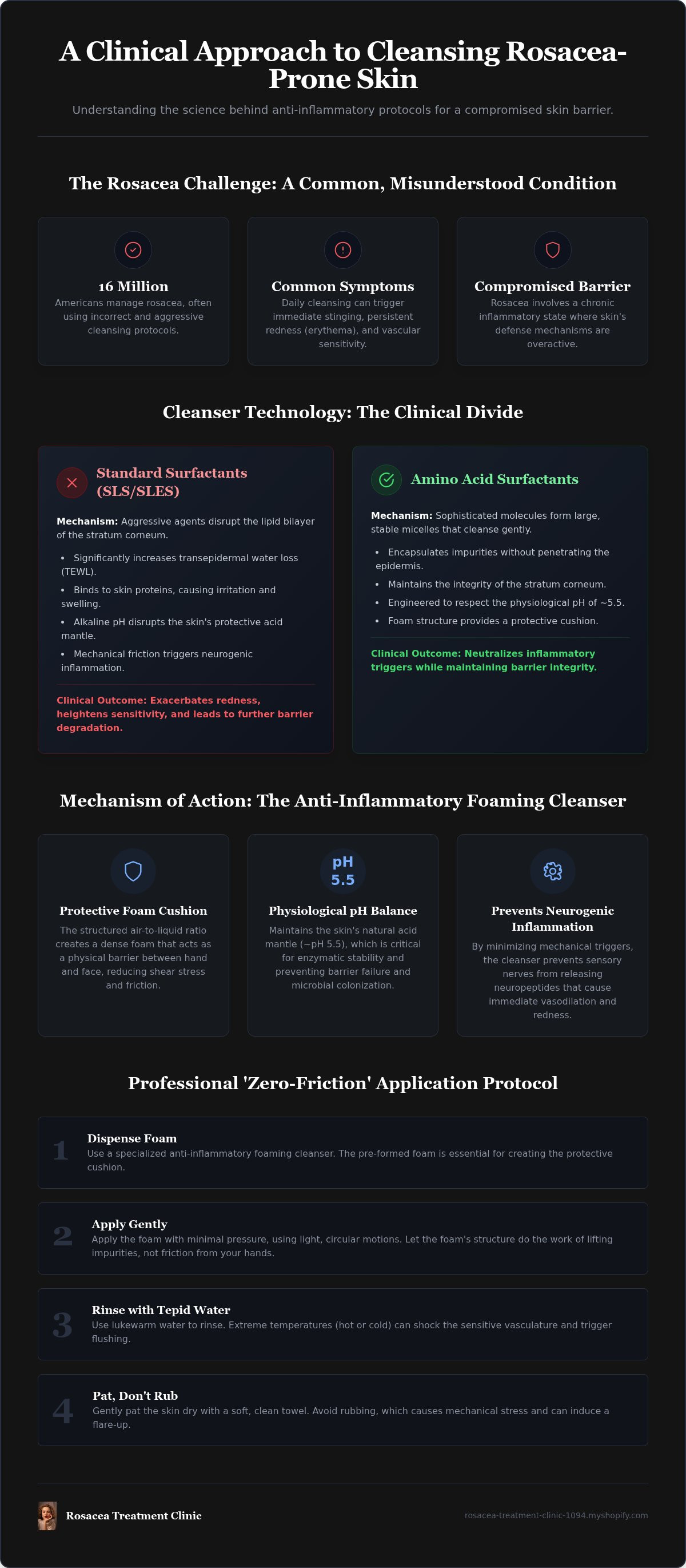
Standard surfactants such as Sodium Lauryl Sulfate (SLS) or Sodium Laureth Sulfate (SLES) are clinically contraindicated for rosacea patients. These aggressive agents disrupt the lipid bilayer of the stratum corneum, significantly increasing transepidermal water loss (TEWL). For individuals with compromised barriers, this disruption exacerbates telangiectasia and heightens vascular sensitivity. The primary clinical objective during the wash cycle is to neutralize inflammatory triggers while maintaining the integrity of the skin's protective shield.
Vascular Sensitivity and the Cleansing Trigger
Mechanical friction during the cleansing process often induces neurogenic inflammation. This occurs when sensory nerves in the skin release neuropeptides that trigger immediate vasodilation and plasma extravasation. Neurogenic inflammation in rosacea is the physiological response where physical or chemical stimuli activate cutaneous nerves to release inflammatory mediators. Harsh surfactant residues that remain on the skin can penetrate the compromised barrier, sustaining a state of chronic irritation. A specialized Anti-Inflammatory Foaming Cleanser utilizes its foam structure as a physical cushion to minimize this mechanical stress during application.
Spectrum Analytical Laboratory Foundations
The development of high-efficacy protocols at the Rosacea Treatment Clinic relies on foundational research conducted by Spectrum Analytical Laboratory in the mid-1980s. This research was pivotal in identifying specific non-irritating agents capable of cleansing the skin without triggering the innate immune response. Transitioning from traditional alkaline soaps to specialized dermatological protocols is a clinical necessity for long-term stabilization. These non-prescription clinical solutions prioritize the restoration of the stratum corneum through methodical, research-backed formulations that avoid the rebound inflammation often seen with generic drugstore options.
Mechanism of Action: How Anti-Inflammatory Foaming Cleansers Stabilize Skin
The stabilization of a reactive skin barrier requires a precise chemical intervention during the cleansing cycle. While traditional cleansers rely on high surfactant concentrations to emulsify oils, an Anti-Inflammatory Foaming Cleanser utilizes a structured air-to-liquid ratio to create a protective cushion. This foam density isn't merely aesthetic; it serves as a physical barrier between the hand and the facial tissue, reducing the shear stress that typically triggers neurogenic inflammation. By minimizing mechanical friction, the formulation prevents the activation of sensory nerves and subsequent vasodilation.
Maintaining a physiological pH of approximately 5.5 is a critical requirement for enzymatic stability within the stratum corneum. Alkaline environments disrupt the acid mantle, leading to immediate barrier failure and increased susceptibility to microbial colonization. Specialized foaming matrices are engineered to respect this acidic threshold, ensuring that the cleansing process doesn't facilitate further inflammatory signaling. This systematic approach preserves the skin's natural defense mechanisms while removing environmental pollutants and cellular debris.
Surfactant Selection for Compromised Barriers
Dermatological protocols for rosacea prioritize amino acid-based surfactants over traditional sulfates like SLS. These sophisticated molecules form large, stable micelles that encapsulate impurities without penetrating the deeper layers of the epidermis. Unlike sulfates, which can bind to skin proteins and cause swelling, amino acid-derived surfactants maintain the integrity of the intercellular lipid bilayer. The resulting foam density provides a high-surface-area cleansing action that requires less physical agitation. This is vital for patients with papulopustular subtypes who require thorough soil removal without mechanical trauma.
Active Ingredients for Redness Suppression
The efficacy of specialized cleansing extends beyond surfactant safety. High-performance formulations incorporate a synergy of hydrating agents and synthetic anti-inflammatory compounds designed to remain bioavailable during the short contact time of a wash. Clinical evidence supports integrating OTC skincare containing these targeted actives to suppress pro-inflammatory cytokines. This ensures that the cleansing step actively contributes to the reduction of erythema rather than serving as a neutral or irritating event.
To maintain medical-grade standards, these formulations must remain fragrance-free and essential oil-free. These additives are common triggers for flushing and neurosensory stimulation. By utilizing a clean, purposeful matrix, the Anti-Inflammatory Foaming Cleanser provides a reliable foundation for subsequent therapeutic steps. This methodical approach ensures that the first step in a patient's regimen actively contributes to vascular stability rather than undermining it.
Clinical Comparison: Foaming Agents vs. Cleansing Emulsions
Clinical selection of a cleansing medium depends on the specific rosacea subtype and present sebum levels. While both formats aim to maintain barrier integrity, their mechanisms for soil removal and lipid preservation differ significantly. An Anti-Inflammatory Foaming Cleanser is often the preferred intervention for patients exhibiting papulopustular rosacea or those with higher sebaceous activity. Conversely, the Hydrating Desensitising Cleansing Emulsion serves as a lipid-replenishing agent for patients with extreme xerosis or Erythematotelangiectatic Rosacea (ETR) where sebum production is minimal.
Subtype-Specific Cleansing Protocols
Patients with papulopustular rosacea frequently experience localized congestion and inflammatory lesions that require efficient debris removal. Foaming agents utilize specialized surfactants to lower surface tension, allowing the solution to encapsulate lipophilic impurities and environmental pollutants without deep dermal penetration. For ETR patients with a highly transparent, dry epidermis, the Hydrating Desensitising Cleansing Emulsion provides a protective film that mimics the skin's natural acid mantle. While emulsions focus on lipid-replacement for severely dry barriers, foaming agents provide superior debris-removal for congested or oily subtypes. This distinction ensures that the cleansing process does not contribute to follicular blockage or exacerbate existing pustules.
Friction and Mechanical Irritation Analysis
The 'slip' factor in a clinical formulation determines the degree of mechanical stress applied to the vascular network during washing. A high-density foam acts as a lubricant, providing a thicker physical buffer than many thin emulsions. This cushioning effect is vital for highly reactive skin, as it prevents the hand-to-face contact pressure that often leads to immediate flushing. The integration of natural anti-inflammatory ingredients for rosacea within this foam matrix further suppresses the neurogenic response during the application phase.
There is a persistent clinical myth that all foaming actions are inherently drying. This assumption stems from the historical use of harsh sulfates in commercial soaps. Modern, research-based formulations like the Anti-Inflammatory Foaming Cleanser utilize amino acid-derived surfactants that preserve the intercellular cement of the stratum corneum. These advanced surfactants offer excellent rinse-off efficacy, ensuring that no irritating residue remains on the skin to trigger post-wash erythema. This clean-rinse profile is a significant advantage over heavier emulsions, which may leave a film that interferes with the absorption of secondary repair treatments.
Professional Application Protocol: Minimizing Cleansing-Induced Flares
The efficacy of an Anti-Inflammatory Foaming Cleanser is heavily dependent on the application technique. Even a high-performance formulation can induce vascular distress if applied with excessive mechanical force or at incorrect temperatures. In a clinical setting, the cleansing stage is treated as a controlled therapeutic intervention. The primary objective is the removal of environmental pollutants and excess lipids without triggering the neurogenic inflammatory response discussed in previous sections.
Temperature regulation is a non-negotiable requirement for vascular stability. Hot water acts as a potent vasodilator, while excessively cold water can cause a rebound flushing effect. Tepid water is the clinical standard, as it effectively softens surface debris without stimulating the cutaneous blood vessels. Contact time should be limited to 30 to 60 seconds. This duration allows for the absorption of anti-inflammatory agents without over-cleansing or disrupting the delicate acid mantle.
The Step-by-Step Clinical Wash
Adhering to a structured protocol ensures consistent results and minimizes the risk of post-wash erythema. This methodical approach prioritizes barrier protection at every stage:
- Pre-wash preparation: Perform thorough hand hygiene. Calibrate water to a tepid temperature before it contacts the facial tissue.
- Foam activation: Dispense the cleanser into damp palms and work into a dense foam. This creates the necessary air-to-liquid matrix required for the 'Zero-Friction' method.
- Application: Apply the foam to the face using a light, circular motion. The foam should act as a physical cushion, preventing direct hand-to-skin pressure.
- Rinsing and drying: Rinse thoroughly with tepid water. Use the 'pat-dry' rule with a clean, soft towel. Never drag the towel across the skin, as this mechanical friction can induce immediate inflammation.
Common Cleansing Errors in Rosacea Care
Many patients inadvertently compromise their treatment by adopting aggressive cleansing habits. Double-cleansing with heavy oils or balms can be problematic for rosacea subtypes. These products frequently leave behind a residual film that requires further friction to remove, or they contain emulsifiers that penetrate the stratum corneum. Physical exfoliants, washcloths, and rotating brushes are generally contraindicated. These tools cause micro-tears in the skin barrier and stimulate pro-inflammatory cytokines.
Distinguishing between a cleanser-induced flare and an environmental trigger is essential for protocol adjustment. If stinging or redness occurs immediately during or after the wash, it's likely a result of incorrect technique or an unsuitable surfactant. Once the skin is stabilized and pat-dried, it's prepared for the next stage of the regimen. For optimal results, integrate the Anti-Inflammatory Foaming Cleanser into your daily routine to ensure a calm, receptive base for the Reprieve Serum Pure protocol .
The Rosacea Treatment Clinic Solution: Research-Based Cleansing
The Rosacea Treatment Clinic has specialized in non-prescription, high-efficacy dermatological protocols since 1996. Our foundational approach relies on research conducted by Spectrum Analytical Laboratory in the mid-1980s, which identified specific agents capable of cleaning the skin without triggering the innate immune response. The Anti-Inflammatory Foaming Cleanser represents the culmination of this research, offering a systematic solution for patients who have failed to find relief with generic drugstore options. By prioritizing the stabilization of the compromised skin barrier, this formulation serves as the necessary starting point for all clinical interventions.
Our methodology eschews temporary cosmetic fixes in favor of long-term barrier health. While many products focus on masking redness, our protocols aim to suppress the underlying inflammatory pathways. This requires a methodical integration of cleansing with secondary repair treatments. Once the skin is cleansed and stabilized, it's prepared to receive the Original Repair Treatment Fluid or the Original Repair Treatment Cream. These subsequent steps work in tandem with the cleansing process to foster a resilient stratum corneum and reduce vascular sensitivity over time.
Formulation Integrity and Clinical Standards
Formulation integrity is maintained through the strict exclusion of prescription-grade irritants and common allergens. We prioritize research-backed topicals that deliver results without the rebound inflammation often associated with more aggressive treatments. This commitment to safety allows the clinic to distribute professional-grade protocols globally, providing a reliable resource for those managing chronic facial redness. To further protect the skin from environmental triggers, we recommend the Antioxidant Radiance Defence Shield as a secondary protective layer. This shield reinforces the barrier against oxidative stress, ensuring that the benefits of the Anti-Inflammatory Foaming Cleanser are preserved throughout the day.
Next Steps in Your Treatment Protocol
Transitioning from the cleansing phase to active repair is a critical sequence in rosacea management. After the skin has been properly prepared, specialized serums like Reprieve Serum Pure can be applied to target deep-seated inflammation. For patients dealing with post-inflammatory discoloration or uneven skin tone, consulting the New Tone Harmonizing Protocol offers a structured path toward aesthetic clarity. This sequential approach ensures that every product in the regimen serves a specific, functional purpose within a larger system of care.
Vascular stability also requires a mandatory commitment to sun protection. Following your morning cleansing routine, the application of High Extended UVA Protection Sunscreens is essential to prevent UV-induced cytokine release. By adhering to this professional protocol, you create a controlled environment where the skin can finally begin the process of restoration. To begin your journey toward a stabilized barrier, evaluate the Anti-Inflammatory Foaming Cleanser for your protocol.
Establishing a Stabilized Foundation for Long-Term Remission
Effective rosacea management requires a shift from aggressive hygiene to methodical inflammation suppression. This analysis has detailed how specialized surfactants and pH-balanced formulations prevent the neurogenic triggers that drive chronic facial redness. By adhering to a professional protocol that prioritizes barrier integrity, patients can bypass the cycle of post-wash erythema and stinging. The Rosacea Treatment Clinic has provided non-prescription dermatological support for chronic redness since 1996, utilizing protocols built upon foundational Spectrum Analytical Laboratory data.
Integrating an Anti-Inflammatory Foaming Cleanser provides the necessary physical cushion and chemical stability required for highly reactive skin types. This systematic approach transforms the daily wash into an active therapeutic step, preparing the epidermis for the subsequent repair and protection phases of your regimen. Professional-grade cleansing ensures that the stratum corneum remains intact while surface impurities are removed with surgical precision.
Secure the Anti-Inflammatory Foaming Cleanser for your clinical protocol. Establishing a calm, receptive base is a vital step toward achieving a resilient and healthy skin barrier.
Frequently Asked Questions
Is a foaming cleanser safe for vascular rosacea?
Yes, provided the formulation utilizes non-stripping, amino acid-based surfactants rather than traditional sulfates. These specialized agents create a high-density foam that serves as a physical cushion, reducing the mechanical friction that typically triggers vascular flushing. This 'Zero-Friction' approach is essential for protecting the fragile capillary networks associated with erythematotelangiectatic rosacea.
What ingredients should I avoid in a cleanser for facial redness?
You must strictly avoid Sodium Lauryl Sulfate (SLS), synthetic fragrances, and essential oils such as menthol or peppermint. These substances are known vasodilators and barrier disruptors that exacerbate neurogenic inflammation. Additionally, physical exfoliants and alkaline soaps should be eliminated from your protocol to prevent further degradation of the stratum corneum.
How often should I use an anti-inflammatory cleanser if my skin is very dry?
Standard clinical protocol suggests twice-daily application, though patients with extreme xerosis may benefit from alternating with a Hydrating Desensitising Cleansing Emulsion. A specialized Anti-Inflammatory Foaming Cleanser is engineered to maintain lipid integrity, meaning it doesn't strip the skin's natural oils like generic drugstore options. This ensures a clean surface without inducing the tightness or flaking often seen with high-detergency washes.
Can I use the Anti-Inflammatory Foaming Cleanser with prescription rosacea creams?
Yes, this cleanser is specifically designed to function as a foundational step for secondary therapeutic interventions. By normalizing the skin’s pH and stabilizing the barrier, it creates a receptive environment for prescription topicals. This preparation ensures that active ingredients are absorbed efficiently without the interference of surface debris or a compromised acid mantle.
Why does my face get redder after washing, even with gentle products?
Post-wash erythema is frequently a result of neurogenic inflammation triggered by mechanical pressure or incorrect water temperature. Even if a product is chemically gentle, the act of scrubbing or using a washcloth can stimulate the release of pro-inflammatory neuropeptides. Adopting a methodical 'pat-dry' rule and utilizing foam as a protective buffer are the primary ways to mitigate this response.
Do I need a separate makeup remover before using an anti-inflammatory cleanser?
In most cases, a separate remover is unnecessary because the foaming action effectively encapsulates lipophilic impurities and environmental pollutants. For patients using heavy water-resistant sunscreens, a preliminary application of Pre-Cleansing Emulsifier followed by the foaming cleanser provides a thorough, non-irritating double-cleanse. This sequence ensures complete soil removal without requiring aggressive physical agitation.
What is the difference between this cleanser and a standard drugstore foaming wash?
Standard drugstore washes often rely on high-detergency surfactants designed for oily, non-reactive skin, which can strip the intercellular cement of the epidermis. Our clinical formulation is based on Spectrum Analytical Laboratory research from the mid-1980s, prioritizing non-prescription anti-inflammatory agents. It focuses on long-term barrier restoration and vascular stability rather than just surface-level hygiene.
Should I use cold or warm water when cleansing rosacea-prone skin?
Tepid water is the clinical requirement for maintaining vascular stability. Hot water acts as a potent vasodilator, while excessively cold water can cause a rebound flushing effect as the skin attempts to re-regulate its temperature. Using water that matches the skin's natural temperature prevents the thermal stress that triggers inflammatory cytokine release.