
The gold standard for cellular renewal might be the primary catalyst for your persistent facial redness. For the estimated 16 million Americans managing this condition, traditional Vitamin A often triggers an inflammatory response that outweighs its anti-aging benefits. You've likely experienced the frustration of attempting to improve skin texture only to face a compromised barrier, thinning skin, and increased sensitivity.
Achieving professional-grade resurfacing and collagen support is possible without inducing a flare-up. This clinical guide explores effective retinoid alternatives for rosacea, focusing on ingredients like bakuchiol and azelaic acid that provide stimulus without aggression. You'll learn how to secure the benefits of cellular turnover while maintaining a stable, non-reactive skin barrier through specialized, research-based interventions.
We'll analyze the latest 2026 clinical data from Spectrum Analytical Laboratory and outline a precise night-time protocol. This systematic approach replaces "miracle" ingredient claims with a structured, medical-adjacent strategy designed to restore skin health without the standard irritation profile of prescription Vitamin A.
Key Takeaways
- Identify the biological triggers of retinoid dermatitis and learn how to bypass the inflammatory cascade associated with standard Vitamin A.
- Evaluate the clinical efficacy of various retinoid alternatives for rosacea, including the specific roles of bakuchiol and peptides in collagen synthesis.
- Differentiate between foundational renewal and advanced stimulus using the Evening Pure Stimulus Serum and its concentrated Booster counterpart.
- Implement a structured application protocol that prioritizes barrier integrity, starting with a mandatory anti-inflammatory cleansing phase.
- Configure a customized clinical system from the Retinoids collection to address specific dermatological concerns such as persistent redness or aging texture.
The Retinoid Dilemma: Why Standard Vitamin A Fails Rosacea Skin
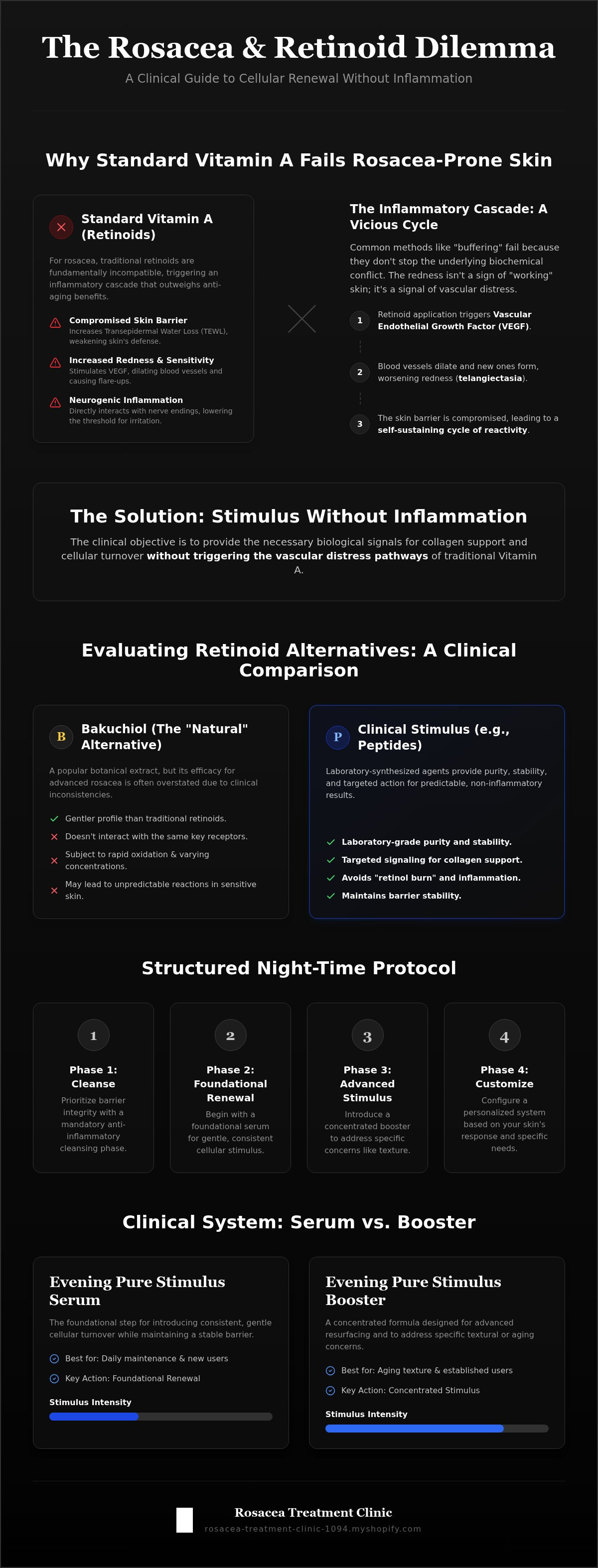
Standard retinoids are often fundamentally incompatible with the reactive dermatological profile. While the beauty industry frequently suggests "buffering" or "sandwiching" Vitamin A, these methods fail to address the underlying biochemical conflict. For those seeking retinoid alternatives for rosacea, the objective isn't merely to reduce irritation but to bypass a specific inflammatory cascade that traditional formulas inevitably trigger.
Retinoid Dermatitis in rosacea patients isn't a standard adjustment period. It's a manifestation of acute barrier failure. In healthy skin, Vitamin A might cause temporary "purging" as cellular turnover increases. In a comprehensive overview of rosacea, the condition is defined by pre-existing vascular instability and a compromised immune response. Standard retinol triggers the release of Vascular Endothelial Growth Factor (VEGF). This protein stimulates the formation of new blood vessels and dilates existing ones, directly exacerbating the persistent redness and telangiectasia characteristic of the condition.
Vascular Reactivity and the Vitamin A Pathway
Retinoic acid interacts directly with sensitive nerve endings in the dermis, lowering the threshold for neurogenic inflammation. This interaction increases Transepidermal Water Loss (TEWL), which significantly compromises the stratum corneum. When the barrier is breached, environmental irritants penetrate deeper into the skin layers, creating a self-sustaining cycle of reactivity. Simply diluting a standard retinol cream with a moisturizer doesn't stop the VEGF pathway; it only slows the inevitable barrier collapse. The resulting redness isn't a sign of "working" skin; it's a signal of vascular distress.
The Clinical Requirement for Cellular Renewal
Despite these risks, complete avoidance of renewal agents isn't a viable long-term strategy for skin health. Rosacea-prone skin still requires assistance with cellular turnover to prevent skin thickening, follicular congestion, and irregular texture. Spectrum Analytical Laboratory research indicates that a "Stimulus without Inflammation" approach is necessary for this demographic. By selecting specific retinoid alternatives for rosacea, clinicians can provide the necessary biological signals for collagen support without triggering the vascular pathways of traditional Vitamin A.
Transitioning from total avoidance to methodical, specialized management allows for professional-grade results without the risk of a chronic flare-up. Using the Evening Pure Stimulus Serum ensures the skin receives the necessary stimulus for repair while maintaining a stable, non-reactive environment. This shift ensures the skin receives the benefits of resurfacing without the catastrophic inflammatory consequences of standard retinoids.
Evaluating Retinoid Alternatives: Bakuchiol vs. Clinical Stimulus
Bakuchiol is often categorized as the primary choice among retinoid alternatives for rosacea. While a 2026 study published in Skin Research and Technology demonstrated that bakuchiol can improve skin lightening and color consistency over 12 weeks, its efficacy for advanced rosacea profiles is often overstated. Unlike traditional retinoids, bakuchiol doesn't interact with the same retinoic acid receptors. It offers a gentler profile but may lack the specialized cellular communication required to manage the thickening and texture changes specific to chronic vascular inflammation.
The Limits of Natural Alternatives
The "natural" label frequently masks clinical inconsistencies. Botanical extracts are subject to rapid oxidation and varying concentrations, which can lead to unpredictable reactions in reactive skin. In a recent update on the treatment of rosacea, researchers emphasized that topical interventions must prioritize barrier stability over aggressive botanical actives. For patients with severe vascular reactivity, laboratory-synthesized stimulus agents provide a level of purity and stability that plant-derived extracts cannot match. Peptides, for instance, offer a targeted method for collagen support that avoids the standard "retinol burn" by focusing on signaling pathways rather than surface-level irritation.
The Science of Stimulus Pure Technology
The Evening Pure Stimulus Serum represents a shift in how we approach retinoid alternatives for rosacea. Traditional retinoids work via aggressive surface exfoliation, which thins the already fragile epidermis of a rosacea patient. In contrast, Pure Stimulus technology utilizes a specialized Vitamin A derivative protocol that bypasses the epidermis to target the dermis directly. This deep cellular communication encourages repair and renewal from the inside out.
The clinical protocol favors a low-dose, high-frequency application strategy. This methodical approach ensures the skin receives a steady signal for renewal without reaching the threshold of inflammatory failure. It allows patients to achieve the sought-after "glow" of cellular health without the characteristic "flush" of a flare-up. By prioritizing structural integrity, this technology offers a predictable outcome for complex dermatological needs. Patients ready to move beyond standard retail options should consider a specialized clinical collection to secure the precision required for long-term barrier management.
Comparative Analysis: Evening Pure Stimulus Serum vs. Booster
The selection of clinical retinoid alternatives for rosacea requires a nuanced understanding of concentration and delivery systems. Within the Spectrum Analytical Laboratory framework, the protocol is divided into foundational renewal and advanced intervention. This modular approach ensures that the skin’s threshold for stimulus is never exceeded, preventing the vascular dilation common in traditional treatments. Selecting the correct starting point depends on the specific rosacea subtype and the current state of the skin barrier.
The Foundational Protocol: Evening Pure Stimulus Serum
The Evening Pure Stimulus Serum serves as the primary entry point for reactive dermatological profiles. It's specifically engineered for patients with erythematotelangiectatic rosacea, where persistent redness and visible blood vessels are the primary concerns. This formulation prioritizes a steady, low-impact stimulus that targets fine lines and uneven tone without disrupting the fragile stratum corneum.
For optimal results, this serum is often paired with the Hydrating Serum to maintain critical moisture balance and mitigate transepidermal water loss. Clinical observations over the first 30 days typically show:
- A measurable reduction in surface roughness and tactile sensitivity.
- Stabilization of the skin barrier against common environmental triggers.
- Improved light reflection and a visible reduction in sallow skin tones.
The Advanced Intervention: Evening Pure Stimulus Booster
Transitioning to the Evening Pure Stimulus Booster is recommended only after the skin has demonstrated three to four months of stability with the foundational serum. This concentrated formula is designed for advanced protocols, particularly for those with papulopustular rosacea or stubborn texture issues. The booster provides a more intensive signal for cellular turnover, making it highly effective for resolving follicular congestion and addressing skin thickening.
Safety parameters are paramount when utilizing high-potency retinoid alternatives for rosacea. The booster's texture is more viscous, allowing for precise, localized application on specific areas of concern rather than a full-face sweep. This targeted method limits the risk of systemic irritation while maximizing efficacy. Most patients find that a structured cycle of the booster, followed by a return to the foundational serum, provides the best balance of long-term stimulus and barrier defense. This methodical progression ensures that the skin remains in a state of repair rather than a state of reaction.
The Implementation Protocol: Integrating Stimulus into Your Routine
Success with clinical renewal requires a systematic approach rather than the isolated application of active ingredients. The "sandwich method" often recommended in casual skincare circles lacks the precision needed for reactive dermatological profiles. A professional protocol ensures that retinoid alternatives for rosacea provide structural benefits without breaching the inflammatory threshold. This requires a modular sequence: Cleanse, Hydrate, Stimulate, and Repair.
Cleansing and Barrier Preparation
Cleansing is the non-negotiable foundation of this protocol. This process begins with the Pre-Cleansing Emulsifier to dissolve environmental pollutants and lipid-soluble debris. Following this with the Hydrating De-Sensitizing Cleansing Emulsion stabilizes the barrier and prepares the skin for stimulus or alternatively using the Anti-Inflammatory Foaming Cleanser ensures surface pathogens and inflammatory markers are removed before active application. A clean canvas prevents the accidental migration of active ingredients into the sensitive ocular area, significantly reducing the risk of secondary irritation.
Adherence to the 2-2-2 Introduction Rule is mandatory for managing cellular adjustment periods. Introduce your chosen stimulus twice weekly for the first two weeks. If the skin barrier remains stable, increase application to three times weekly for the subsequent two weeks. This methodical pacing allows the skin to adapt to increased cellular turnover without triggering a vascular response. You must monitor the "Rosacea Threshold" daily. Any increase in localized heat, persistent stinging, or morning-after redness indicates a need to pause the protocol for 48 hours to allow for barrier recovery.
The Post-Stimulus Repair Phase
The application of retinoid alternatives for rosacea must always be followed by a dedicated repair phase. The Night Repair Cream provides the essential lipids necessary to seal the stimulus serum into the dermis while shielding the epidermis from moisture loss. For advanced protocols or those with significant thinning, the Intensive Night Nurturing Complex works synergistically with the stimulus agents to accelerate structural recovery. The Repair Phase is the critical window for epidermal structural reinforcement.
Establishing a predictable environment for your skin is the only way to achieve long-term results. By following a structured clinical sequence, you move away from reactive "damage control" and toward proactive health management. To begin your systematic transition to non-inflammatory renewal, access the specialized Retinoids collection to select your foundational protocol.
Selecting Your Clinical Protocol: The Retinoids Collection
The 5-product Retinoids collection operates as a unified, modular system rather than a set of standalone items. This systematic approach ensures that every stage of cellular renewal is supported by barrier defense. Selecting the correct clinical protocol depends on your primary dermatological objective: neutralizing persistent redness, refining irregular texture, or addressing structural aging. By aligning your product selection with your specific rosacea subtype, you ensure the skin receives the necessary stimulus without exceeding its inflammatory threshold.
Protocol for Early Intervention (Prevention)
The early intervention protocol is optimized for patients experiencing intermittent flushing and the initial emergence of fine lines. This sequence utilizes the Evening Pure Stimulus Serum in combination with the Hydrating Serum. This pairing provides a low-impact stimulus that improves radiance and skin tone without compromising the stratum corneum. By maintaining barrier integrity through consistent hydration, the skin remains resilient against environmental triggers while benefiting from baseline cellular turnover. It's the ideal starting point for maintaining a youthful texture while managing early-stage vascular reactivity.
Protocol for Advanced Resurfacing (Correction)
For individuals with established skin thickening or persistent textural irregularities, an advanced resurfacing protocol is required. This booster-centric approach utilizes the concentrated stimulus of the Evening Pure Stimulus Booster to target stubborn areas of congestion and structural decline. To ensure maximum efficacy and minimize the risk of vascular reactivity, the booster is paired with the Original Repair Treatment Fluid. This combination accelerates structural recovery and reinforces the dermal matrix. You can browse the clinical Retinoids collection to identify the specific components for your corrective protocol.
Any renewal protocol increases the skin’s vulnerability to ultraviolet radiation. High UVA protection is a non-negotiable requirement when using retinoid alternatives for rosacea. Products like Attend SPF 50 provide the necessary defense against photo-induced inflammation, which can otherwise negate the benefits of stimulus serums. Failure to apply high-extended UVA protection daily can lead to secondary barrier failure and increased vascular sensitivity. This defensive layer is the most critical component of your morning routine.
Long-term rosacea maintenance relies on the methodical application of these research-based protocols. The objective is to sustain a state of controlled renewal where the skin receives constant signals for repair without ever reaching the inflammatory threshold. Adhering to a clinical system derived from Spectrum Analytical Laboratory research ensures your skin remains stable, non-reactive, and structurally sound. This methodical transition from aggressive retail products to specialized clinical protocols provides the only predictable pathway to professional-grade skin resurfacing for the rosacea-prone profile.
Advancing Your Clinical Renewal Strategy
Achieving professional resurfacing results requires a departure from the "retinol dilemma" and a shift toward specialized, research-based stimulus. The inflammatory cascade triggered by traditional Vitamin A is not a mandatory trade-off for collagen support or texture refinement. By utilizing retinoid alternatives for rosacea derived from Spectrum Analytical Laboratory research, you can bypass vascular dilation while securing essential dermal structural reinforcement. This methodical approach ensures that your skin remains stable and non-reactive throughout the renewal process.
Since 1996, our specialized formulations have provided a disciplined pathway for reactive skin management. These non-prescription protocols prioritize epidermal integrity, ensuring that cellular turnover occurs without the risk of barrier failure or chronic flushing. Success is found in the clinical sequence: a methodical introduction of stimulus serums followed by intensive lipid restoration. This structured environment allows your skin to heal and advance simultaneously. Explore the Research-Based Retinoids Collection to select the specialized protocol appropriate for your current dermatological threshold. Stable, professional-grade skin health is an attainable clinical outcome for every rosacea profile.
Frequently Asked Questions
Can I use retinol if I have rosacea?
Standard retinol is often unsuitable for rosacea because it triggers Vascular Endothelial Growth Factor (VEGF). This protein increases blood vessel formation and dilation, exacerbating facial redness. While some individuals attempt to buffer these products, the biochemical pathway remains problematic. Most patients achieve better stability by utilizing specialized retinoid alternatives for rosacea. These clinical formulations provide the necessary stimulus for cellular renewal without breaching the inflammatory threshold of reactive skin.
What is the best retinoid alternative for sensitive, red skin?
The most effective intervention for sensitive, red skin is a laboratory-synthesized stimulus agent rather than a generic retail active. The Evening Pure Stimulus Serum is the foundational choice within our clinical protocols. It utilizes a specific Vitamin A derivative designed to target the dermis while bypassing the epidermal irritation associated with traditional formulas. This ensures the skin receives structural support and texture refinement without triggering the neurogenic inflammation common in standard anti-aging products.
Is Bakuchiol safe for rosacea sufferers?
Bakuchiol is considered a safe, plant-derived option, but it has clinical limitations for complex rosacea profiles. While it offers anti-inflammatory benefits, botanical extracts can be unstable and vary in potency. For those with significant vascular reactivity, a synthesized clinical stimulus provides more predictable results. Bakuchiol serves as a baseline alternative, but patients seeking professional-grade resurfacing often require the precision of a structured clinical system to manage chronic texture issues effectively.
How often should I apply a stimulus serum for rosacea?
You should begin application twice weekly for the first 14 days to allow for cellular adjustment. This 2-2-2 rule prevents the skin from reaching its "Rosacea Threshold" too quickly. If the barrier remains stable after this initial period, you can gradually increase frequency to three times weekly. Consistent monitoring for localized heat or stinging is essential. Never accelerate this protocol prematurely, as the skin requires a methodical pace to adapt to increased turnover.
Will retinoid alternatives help with rosacea redness?
These alternatives are primarily designed to improve skin texture and collagen support without exacerbating redness. While they don't treat the underlying vascular condition directly, they help prevent the skin thinning that makes redness more visible. By strengthening the dermal matrix, retinoid alternatives for rosacea contribute to a more resilient, less reactive appearance. For active redness reduction, these should be paired with specialized anti-inflammatory agents like the Reprieve Serum Pure.
What should I do if my skin stings after using a stimulus booster?
You must immediately pause the protocol for at least 48 hours if stinging occurs. This sensation indicates a temporary breach in your skin barrier. During this recovery window, focus exclusively on structural reinforcement using the Night Repair Cream or Intensive Night Nurturing Complex. Once all sensitivity has subsided, you can resume the stimulus protocol at a lower frequency. Persistent stinging is a signal to reassess your cleansing routine and barrier defense layers.
Is it necessary to use sunscreen with retinoid alternatives?
High-extended UVA protection is a mandatory requirement when using any renewal agent. Stimulus serums increase cellular turnover, which leaves the new skin cells more vulnerable to ultraviolet damage. Exposure to UVA radiation triggers the very inflammatory pathways you're attempting to avoid. Utilizing a product like Attend SPF 50 daily is the most critical step in your protocol. It ensures that photo-induced inflammation doesn't negate the structural benefits of your night-time care.
Can stimulus serums be used on ocular rosacea areas?
Stimulus serums should generally not be applied to the delicate orbital area or directly on ocular rosacea sites. The skin around the eyes is significantly thinner and more prone to acute barrier failure. For managing ocular symptoms, you should utilize specialized products like the Ocular Conditioning Cleanser and Ocular Soothing Serum. These are formulated specifically for the unique requirements of the eyelid margin and surrounding tissues, providing relief without the risk of stimulus-induced irritation. Minimal application of Evening Pure Stimulus formulas is possible around the eyes providing acclimatisation is followed as above and that Restore Eye Contour Repair Complex is used together with the other two ocular rosacea treatments .