
The Role of UV Radiation as a Rosacea Trigger
For individuals managing Rosacea daily photoprotection is not just an aesthetic consideration but a medical necessity. Ultraviolet (UV) radiation stands as the most significant environmental catalyst for rosacea exacerbation. Understanding its specific mechanisms is the first step toward effective, long-term management and the selection of a therapeutic rosacea sunscreen.
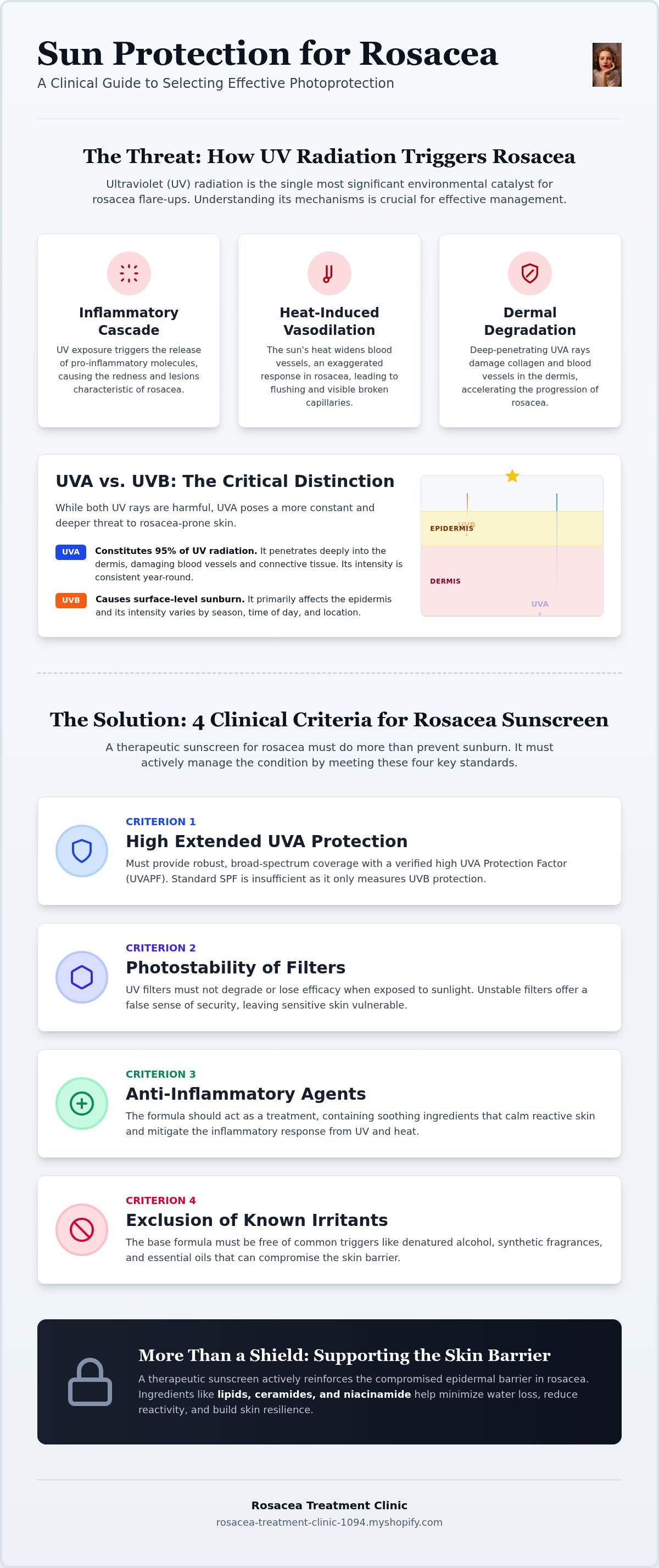
- Inflammatory Cascade Activation: Exposure to UV radiation initiates a complex inflammatory response within the skin. It triggers the release of pro-inflammatory cytokines and cathelicidins, antimicrobial peptides that are pathologically overexpressed in rosacea skin, leading to the characteristic erythema (redness) and inflammatory lesions.
- Distinction Between UVA and UVB: While UVB rays are shorter and primarily responsible for surface-level burning (sunburn), UVA rays penetrate much deeper into the dermis. This deep penetration is particularly damaging for rosacea-prone skin as it degrades the structural integrity of blood vessels and the surrounding connective tissue.
- Heat-Induced Vasodilation: The sun's energy is not limited to UV radiation; it also includes infrared radiation, which is perceived as heat. This thermal energy causes vasodilation (widening of blood vessels). In rosacea, this response is exaggerated and can lead to persistent flushing. Over time, repeated episodes of sun-induced vasodilation can damage the fragile capillaries, leading to the formation of permanent telangiectasia (visible broken blood vessels).
UVA Radiation and Dermal Degradation
UVA radiation constitutes approximately 95% of the UV light that reaches the Earth's surface, making it a constant environmental stressor. Unlike UVB, its intensity remains relatively consistent throughout the day and year, and it can penetrate clouds and glass. Its longer wavelength allows it to reach the dermal layer, where it damages the delicate vascular network that is already compromised in rosacea patients. This deep-level damage is a primary driver of the chronic, progressive nature of the condition. In rosacea-prone skin, UVA-induced oxidative stress overwhelms the skin's natural antioxidant defenses, leading to cellular damage and a sustained inflammatory state.
Thermal Triggers and Photodermatology
The heat component of sunlight acts as a potent, independent trigger for rosacea flushing. This is a key distinction between a standard sunburn and a rosacea flare-up. A sunburn is a direct inflammatory response to cellular DNA damage from UVB. A rosacea flare, however, is often a rapid vascular reaction to heat and UV-induced inflammation, causing immediate and often prolonged redness. Even incidental sun exposure—such as walking to a car or sitting near a window—contributes to this cumulative burden. Each exposure, no matter how brief, can subtly compromise the skin's barrier function, increasing transepidermal water loss (TEWL) and leaving the skin more susceptible to other environmental triggers.
Essential Clinical Criteria for Rosacea Sunscreen
Selecting a sunscreen for rosacea requires a more stringent evaluation than for non-sensitive skin. The goal extends beyond simple sunburn prevention to active management of the condition. A clinically appropriate rosacea sunscreen must meet four essential criteria to provide therapeutic benefit and prevent flare-ups.
- Requirement 1: High Extended UVA Protection: The formulation must offer robust, broad-spectrum coverage with a verified high protection factor against UVA rays (UVAPF). This is critical for preventing the deep dermal damage that exacerbates rosacea symptoms.
- Requirement 2: Photostability of Filters: The UV filters used in the sunscreen must be photostable, meaning they do not degrade or lose their efficacy upon exposure to sunlight. Unstable filters can provide a false sense of security and leave the skin unprotected.
- Requirement 3: Inclusion of Anti-Inflammatory Agents: An ideal rosacea sunscreen should function as part of a treatment protocol. The inclusion of soothing, anti-inflammatory ingredients helps to calm reactive tissue and mitigate the inflammatory cascade initiated by UV and thermal exposure.
- Requirement 4: Exclusion of Known Irritants: The base formula must be free of common irritants that can compromise the skin barrier and trigger neurosensory irritation. This includes denatured alcohol, synthetic fragrances, essential oils, and certain chemical preservatives.
Understanding High Extended UVA Protection
Standard SPF (Sun Protection Factor) ratings only measure protection against UVB radiation: the rays that cause sunburn. This metric is insufficient for assessing a sunscreen's ability to defend against the more insidious, deeper-penetrating UVA rays. For rosacea management, the UVA Protection Factor (UVAPF) is a far more important clinical indicator. High and "extended" or "long-wave" UVA protection ensures the formula effectively shields against the entire UVA spectrum, which is essential for preventing the degradation of dermal blood vessels and collagen. A truly protective rosacea sunscreen will prioritize and often specify its high UVA defense capabilities. For a detailed analysis of this crucial standard see the High UVA Protection Sunscreens Guide for further clinical context.
Barrier Support and Nurturing Ingredients
Rosacea is fundamentally linked to a compromised epidermal barrier. A therapeutic sunscreen should therefore actively support this barrier. Ingredients like lipids and ceramides help to reinforce the stratum corneum, the skin's outermost layer. This fortification minimizes moisture loss (TEWL) and reduces the skin's reactivity to environmental stressors. In this context, a specialized sunscreen acts as more than just a UV shield; it functions as a secondary barrier repair fluid, locking in hydration and providing a calming buffer between sensitive skin and the environment. Synergistic ingredients work together to ensure the skin remains stabilized and resilient, even during UV exposure.
Mineral vs. Chemical Filters: A Clinical Comparison
The debate between mineral (physical) and chemical (organic) UV filters is a critical one in rosacea care. Historically, mineral filters were preferred, but modern dermatological science has challenged this convention, prioritizing verified protective efficacy over ingredient familiarity.
- Mineral Filters: These include Zinc Oxide and Titanium Dioxide. They primarily work by forming a physical film on the skin that reflects and scatters a portion of UV radiation.
- Organic Filters: This is a broad category of modern filters that work by absorbing UV radiation and converting it into a negligible amount of heat energy, a process that is non-irritating in advanced formulations.
- The Traditional Preference: Inert minerals like Zinc Oxide were traditionally favoured for reactive skin due to a perceived lower risk of irritation. However, this perspective often overlooks their primary functional limitations in photoprotection.
- The Modern Clinical Standard: Professional dermatological protocols now increasingly rely on the evolution of high-tolerance, encapsulated organic filters. These advanced filters are specifically designed to offer superior, photostable, and high-level UVA protection without the significant drawbacks of mineral-only formulations.
Reassessing Mineral Filters in Rosacea Protocols
While Zinc Oxide is inert, its efficacy as a primary sunscreen agent for rosacea is clinically questionable. The core issue lies in the trade-off between cosmetic elegance and protective power. For a mineral-only sunscreen to provide adequate high-level UVA protection, it must be applied as a thick, visibly opaque white layer. Modern micronized and nanoparticle versions, which are formulated to reduce or eliminate this white cast, often fail to provide a uniform, stable film on the skin. This can result in gaps in protection, leaving rosacea-prone skin vulnerable to the very long-wave UVA radiation that drives inflammation and vascular damage.
Relying on a cosmetically acceptable mineral sunscreen may provide a false sense of security while failing to meet the clinical photoprotection standards required for rosacea management.
When to Consider Hybrid and Modern Organic Formulations
The most effective and reliable sunscreens for rosacea today often utilize hybrid formulations or advanced, new-generation organic filters. These products masterfully balance clinical efficacy with cosmetic elegance. By combining mineral filters with modern, encapsulated organic filters, formulators can achieve very high and stable UVA shielding (a high UVAPF) without a heavy texture or white cast. These advanced organic filters are encapsulated in inert polymers, which prevents them from directly contacting the skin, dramatically reducing the potential for irritation and making them suitable for even highly reactive rosacea subtypes. This technology allows for lightweight, comfortable formulas that provide the uncompromising level of UVA defense necessary to prevent deep tissue inflammation and manage conditions like erythematotelangiectatic and papulopustular rosacea effectively.
Application Protocol: Maximizing Protection Without Irritation
How a rosacea sunscreen is applied is as important as the product itself. The goal is to achieve full, even coverage without causing mechanical friction or irritation. A clinical application protocol ensures therapeutic protection and supports overall skin stability.
- Step 1: Barrier Preparation: Apply sunscreen to skin that has been prepped with a specialized, barrier-stabilizing serum. Applying a product like a hydrating or restorative serum first ensures the skin is calm and hydrated, creating a smooth canvas and reducing the potential for sensitivity.
- Step 2: The "Pat and Press" Technique: Avoid rubbing the sunscreen into the skin, as this friction can immediately trigger flushing and irritation. Instead, dispense the product onto your fingertips, dot it evenly across the face, and then gently pat and press it into the skin until it is absorbed.
- Step 3: Quantity Control: Under-application is a primary cause of sun-induced flares. For full, label-rated protection, the face requires approximately 1/4 to 1/3 of a teaspoon of sunscreen. Ensure all areas are covered, including the ears, neck, and hairline.
- Step 4: Reapplication Strategy: Sunscreen efficacy diminishes over time, especially with sweating or exposure to direct, intense sunlight. In high-exposure environments, reapply every two hours. For typical daily activity, a single, thorough morning application is often sufficient if using a highly photostable formula.
Ocular Rosacea and Eye-Safe Application
For those with ocular rosacea, sunscreen application presents a unique challenge, as many formulas can migrate into the eyes and cause severe stinging and irritation. It is crucial to select sunscreens specifically tested and formulated not to run or migrate. When applying sunscreen around the orbital area, use your ring finger to gently pat the product along the orbital bone, avoiding the lash line and eyelids. Utilizing specialized, eye-safe protocols and products is essential for protecting this delicate area without exacerbating ocular symptoms. For more information, please see our complete guide to eye-safe management tips for ocular rosacea.
Clinical Removal: Preventing Product Buildup
Properly removing sunscreen at the end of the day is a non-negotiable step in a rosacea management protocol. Tenacious mineral and water-resistant filters, if not thoroughly removed, can lead to clogged pores and follicular irritation, potentially mimicking or worsening rosacea symptoms. The most effective method is a two-step process known as a double cleanse. Begin with an emulsifying oil to break down the sunscreen, followed by a gentle, pH-balanced cleanser. An Anti-Inflammatory Foaming Cleanser is ideal for the second step, as it effectively removes any remaining residue without stripping the skin's delicate acid mantle, ensuring the barrier remains intact and calm.
The Rosacea Treatment Clinic Photoprotection Protocol
Photo-protection is the cornerstone of every management protocol. Our approach is founded on decades of research, emphasizing the clinical necessity of High Extended UVA Protection Sunscreens as part of a comprehensive, dermatological regimen. We focus on the synergy between daily protection and nightly repair to achieve long-term remission and skin stability.
- Integration into a Research-Based Regimen: Our sunscreens are not standalone products but are designed to be the final, protective step in a multi-part clinical protocol that begins with proper cleansing and barrier-supporting serums.
- Synergy with Restorative Serums: The protective action of our Attend SPF 50 is enhanced when layered over our restorative serums. This combination ensures the skin is not only shielded from external aggressors but is also being actively repaired and desensitized from within.
- Customized Protection Levels: We recognize that skin reactivity can fluctuate. Our protocol allows for customization, with different formulations available to match the skin's current state, from daily maintenance to management of hyper-reactive phases.
- Transition from Protection to Repair: A successful protocol is a 24-hour cycle. Daytime protection seamlessly transitions to an evening routine focused on repair and regeneration, utilizing specialized night serums and creams to undo any incidental environmental damage.
Specialized Sunscreen Formulations
Our photoprotection offerings are formulated based on the clinical needs of rosacea-prone skin, prioritizing high UVA tolerance and therapeutic benefits. The Desensitizing Barrier Fluid SPF 50 is specifically designed for hyper-reactive states, providing a calming, physical shield with potent anti-inflammatory properties for skin in acute distress. For daily, long-term maintenance, the Attend SPF 50 offers elegant, high-performance UVA and UVB protection in a lightweight fluid that is comfortable for everyday use. Both are integral components of our research-based systems, as detailed in the UVA Protection Guide for Reactive and Rosacea Skin.
Adhering to Professional Protocols
The key to successfully managing rosacea and preventing UV-induced degradation is unwavering consistency. Adhering to a professionally designed photoprotection protocol daily—regardless of the weather or time spent indoors—is the most powerful action one can take to maintain long-term skin health and remission. We encourage consulting with a specialist to develop a personalized strategy tailored to your specific rosacea subtype and sensitivity levels. Our commitment at the Rosacea Treatment Clinic is to provide the research-based, dermatological support necessary to achieve and maintain control over this complex condition.