
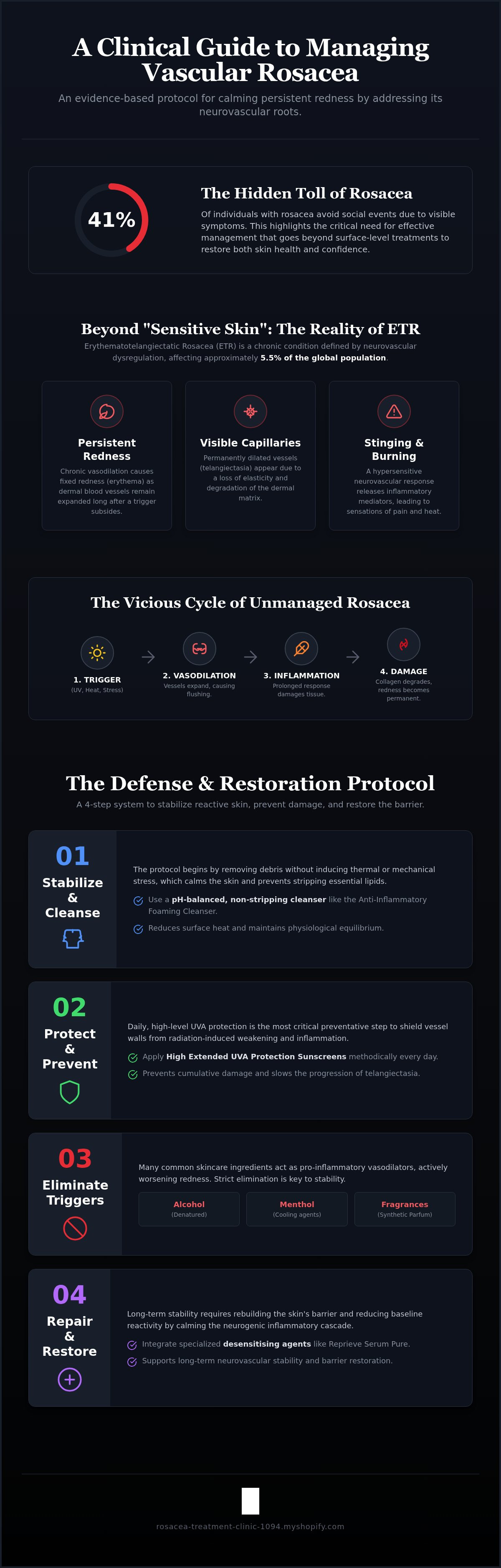
Research indicates that 41% of individuals diagnosed with rosacea have avoided social engagements or canceled plans due to the visibility of their symptoms. For those managing persistent flushing and telangiectasia, the frustration of visible capillaries that remain prominent through makeup is often compounded by the stinging and burning sensations triggered by standard products. Effective skincare for vascular rosacea requires more than generic sensitive skin labels. It demands a methodical, research-based approach to neurovascular stabilization and environmental defense.
You have likely found that traditional hydration routines don't address the underlying vascular pathology of your condition. This guide provides a comprehensive dermatological reference for managing persistent redness through specialized clinical protocols. We will outline a structured system to reduce flushing intensity and stabilize the skin's reactive response. You'll learn how to implement foundational steps, including the use of an Anti-Inflammatory Foaming Cleanser and High Extended UVA Protection Rosacea Sunscreens, to provide the long-term protection necessary for reactive vascular profiles.
Key Takeaways
- Identify the clinical characteristics of Erythematotelangiectatic Rosacea (ETR) to understand how neurovascular dysregulation drives chronic vasodilation and persistent redness.
- Establish a foundational protocol for skincare for vascular rosacea by utilizing the Anti-Inflammatory Foaming Cleanser to stabilize the skin's reactive response.
- Prevent the weakening of vessel walls and the progression of telangiectasia through the methodical application of High Extended UVA Protection Rosacea Sunscreens.
- Eliminate pro-inflammatory vasodilators from your daily regimen, specifically targeting the removal of alcohol, menthol, and synthetic fragrances.
- Support long-term neurovascular stability and barrier restoration by integrating specialized desensitising agents such as Reprieve Serum Pure into your clinical routine.
Clinical Characteristics of Vascular Rosacea: Beyond Surface Redness
Erythematotelangiectatic Rosacea (ETR) is the primary vascular subtype of Rosacea, a condition affecting approximately 5.5% of the global population. It's defined by a fundamental dysfunction in the skin's circulatory and nervous systems. Unlike transient sensitivity, ETR involves chronic neurovascular dysregulation. This condition manifests as sustained vasodilation, where dermal blood vessels remain expanded long after an initial trigger has subsided. Distinguishing between transient flushing (temporary, stimulus-driven redness) and persistent erythema (fixed, chronic redness) is a prerequisite for choosing appropriate skincare for vascular rosacea. Patients typically present with telangiectasia, the clinical term for visible, permanently dilated capillaries. These structures indicate a loss of vessel elasticity and a compromise in the surrounding dermal matrix, a concern shared by many of the 16 million individuals managing this condition in the United States.
The Neurovascular Response in Reactive Skin
The pathology of vascular rosacea involves a hypersensitive dermal nervous system. External triggers activate cutaneous sensory nerves, which release neuropeptides and inflammatory mediators that induce immediate vasodilation. Common triggers include:
- UV radiation and thermal heat
- Psychological stress and emotional shifts
- Mechanical friction or harsh surfactants
In ETR patients, this neurovascular response is both exaggerated and prolonged, leading to characteristic "burning" or "stinging" sensations. A successful management protocol requires a "defense and restoration" approach. This focuses on dampening the neurogenic inflammatory cascade and stabilizing the vascular walls. By prioritizing neurovascular calm, clinicians can reduce the frequency of dilatory episodes that lead to permanent tissue changes.
Long-term Dermal Impact of Unmanaged Vascular Rosacea
Unmanaged vascular reactivity leads to cumulative structural damage. Chronic vasodilation creates a cycle of inflammation that degrades collagen and elastin fibers, resulting in dermal thinning. As this structural support diminishes, blood vessels lose their physical reinforcement, making telangiectasia more prominent and resistant to topical correction. Early intervention is mandatory to prevent the progression from intermittent flushing to permanent facial redness. Integrating the Anti-Inflammatory Foaming Cleanser provides a foundational step for daily vascular stabilization. Utilizing specialized skincare for vascular rosacea helps maintain the dermal architecture and limits the neurovascular triggers that drive disease progression. This methodical application of clinical topicals ensures long-term protection against the structural decline associated with chronic ETR.
Vascular Stabilization Protocols: Selecting Topical Interventions
Topical management of Erythematotelangiectatic Rosacea (ETR) centers on maintaining the epidermal barrier while downregulating the skin's neurovascular response. Effective skincare for vascular rosacea prioritizes the mitigation of surfactant-induced irritation, as standard foaming agents often strip essential lipids. This depletion increases transepidermal water loss and exacerbates vascular reactivity. A pH-balanced, non-stripping approach is essential for long-term stabilization. By selecting formulations that respect the skin's physiological pH, clinicians can prevent the inflammatory signaling that leads to chronic vasodilation.
Cleansing Strategies for the Vascular Subtype
The primary objective of cleansing in vascular-prone skin is the removal of debris without inducing thermal or mechanical stress. The Anti-Inflammatory Foaming Cleanser serves as a foundational tool by utilizing specialized surfactants that reduce surface heat and calm the dermal environment. For patients with severely compromised barriers, the Hydrating Desensitising Cleansing Emulsion provides a lipid-replenishing alternative that maintains physiological equilibrium. Clinical protocols strictly prohibit the use of certain interventions:
- Mechanical exfoliation brushes or abrasive scrubs that cause micro-trauma
- High-temperature water, which induces immediate and intense vasodilation
- Aggressive friction during the drying process, which triggers the neurovascular reflex
Serums vs. Fluids: A Targeted Selection Framework
Selecting appropriate skincare for vascular rosacea involves a modular approach to ingredient delivery. Serums are utilized for deep-layer desensitisation due to their low molecular weight and high concentration of active agents. For acute vascular reactivity, Reprieve Serum Pure provides targeted support to dampen the inflammatory cascade. Conversely, the Original Repair Treatment Fluid focuses on dermal support and structural integrity. Understanding the distinction between these delivery systems is critical for patient outcomes. For a detailed analysis of these formulations, consult our guide on Serum vs Cream for Rosacea: Clinical Selection Criteria.
Stabilizing reactive skin requires balancing lipid restoration with the need to avoid occlusion. Heavy, occlusive ointments can trap metabolic heat, leading to sustained flushing episodes. A lightweight, breathable barrier approach ensures the skin remains protected without triggering a thermal response. To explore a comprehensive range of clinical formulations designed for this purpose, select products based on your specific vascular profile. This methodical approach ensures that every step of the protocol serves to defend and restore the skin's structural and vascular health.
The Critical Role of UVA Protection in Vascular Defense
UVA radiation serves as a primary driver of dermal matrix degradation, acting as a persistent catalyst for vascular decline. While UVB rays are responsible for superficial erythema and acute burning, UVA wavelengths penetrate deeply into the reticular dermis. This deep penetration specifically targets the collagen and elastin fibers that provide the necessary structural support for cutaneous blood vessels. When this matrix is compromised, the vessel walls lose their physical reinforcement. The result is the permanent, visible dilation identified as telangiectasia. For individuals implementing a protocol of skincare for vascular rosacea, photo-protection must address these deep-layer structural concerns rather than focusing solely on surface burn prevention.
UVA vs. UVB: The Vascular Perspective
The distinction between UV wavelengths is fundamental to managing vascular reactivity. UVB radiation induces immediate surface damage. However, UVA radiation is responsible for the 'invisible flare'. This clinical phenomenon occurs when UVA triggers the release of inflammatory mediators and matrix metalloproteinases without causing an immediate thermal sensation or redness. Over time, this cumulative, silent damage facilitates chronic vasodilation and the eventual failure of vascular elasticity. Standard SPF ratings primarily quantify UVB protection, which does not provide a complete metric for vascular patients. Clinical management requires the use of High Extended UVA Protection Sunscreens to shield the deeper dermal environment.
Application Protocols for Maximum Defense
Stabilizing a reactive vascular profile requires a methodical, year-round defense strategy. UVA radiation remains relatively constant across all seasons and easily penetrates standard window glass. This makes daily application mandatory even during indoor activity or in low-light environments. Supplementing the routine with antioxidants helps neutralize UV-induced free radicals that bypass topical filters. This dual-layered approach is a non-negotiable component of skincare for vascular rosacea. For detailed clinical selection criteria, refer to the analysis of the Best Sunscreen for Rosacea: Protect Sensitive Skin. By prioritizing high-level UVA defense patients can decelerate the rate of vascular dilation and preserve the structural integrity of the dermis.
Dermatological Selection Criteria: Avoiding Pro-Inflammatory Ingredients
Successful management of Erythematotelangiectatic Rosacea (ETR) requires the complete elimination of known neurovascular stimulants. Standard skincare for vascular rosacea must exclude a specific "Never-Use" list of ingredients that induce immediate vasodilation or barrier disruption. Alcohol, menthol, and synthetic fragrances are primary offenders. While these ingredients are common in mass-market products, they function as potent irritants for reactive skin. Astringents and toners, often marketed for "deep cleaning," are particularly dangerous in a vascular protocol. These formulations typically rely on volatile alcohols that strip the acid mantle, triggering a rebound inflammatory response and sustained facial flushing.
Chemical Triggers of Vasodilation
Ingredients like camphor and menthol are often included in products for their perceived cooling effect. However, these substances stimulate Transient Receptor Potential (TRP) channels within the dermal nervous system. This stimulation results in a paradoxical increase in blood flow and neurogenic inflammation. Sodium lauryl sulfate (SLS), a common surfactant, further compromises the skin by dissolving the lipid bilayer, allowing environmental irritants to reach sensory nerves. When selecting products, clinicians distinguish between "fragrance-free" and "unscented" labels. Fragrance-free formulations contain no aromatic chemicals, whereas unscented products may utilize masking fragrances to neutralize chemical odors, posing a significant risk to the vascular patient.
The Myth of 'Natural' Skincare for Rosacea
The assumption that organic ingredients are inherently safer is a common misconception in reactive skin management. Essential oils and botanical extracts are complex chemical mixtures. A single plant extract can contain hundreds of volatile compounds, many of which act as potent vasodilators or allergens. Effective skincare for vascular rosacea prioritizes purified, research-backed dermatological formulations over "natural" complexity. Dermatological formulas reduce the risk of cross-reactivity by limiting the total number of ingredients the immune system must process. This methodical approach ensures that every component serves a specific, non-inflammatory purpose in the stabilization of the skin.
Before implementing a new product into a clinical routine, patients should follow a strict jawline patch test protocol. Apply a small amount of the formulation to the lower jawline twice daily for 72 hours. This specific area is highly reactive and provides a reliable indicator of potential neurovascular triggers. If no stinging, burning, or increased erythema occurs, the product may be integrated into the full facial regimen. To establish a safe and effective daily routine explore our specialized clinical collections designed for reactive vascular profiles.
Restorative Management: Barrier Repair and Long-term Stability
Dermal barrier health and vascular reactivity exist in a symbiotic relationship. A compromised stratum corneum facilitates the penetration of environmental irritants, which directly stimulate the underlying neurovascular network. This stimulation leads to the sustained vasodilation and flushing characteristic of ETR. Effective skincare for vascular rosacea must prioritize the restoration of the lipid bilayer to minimize transepidermal water loss (TEWL) and dampen the skin's reactive response. Establishing cutaneous equilibrium requires a methodical, four-step clinical protocol.
- Step 1: Cleansing. Utilize a non-inflammatory formulation to remove debris without disrupting the acid mantle.
- Step 2: Desensitisation. Apply specialized agents like Reprieve Serum Pure to downregulate the neurovascular reflex.
- Step 3: Repair. Integrate lipid-rich formulations to seal the barrier and provide structural support to vessel walls.
- Step 4: Defense. Maintain consistent environmental protection through high-level UVA filtration.
Nighttime Restoration Protocols
The nocturnal period is a critical window for physiological repair. However, many patients experience a "nocturnal flush" due to circadian increases in core body temperature and skin blood flow. Managing this response requires topical support that facilitates recovery without trapping excess heat. The Night Repair Cream provides the necessary lipids to reinforce the barrier during sleep. For advanced support, the Intense Night Nurturing Complex utilizes research-based ingredients to calm reactive pathways. Temperature control in the sleep environment further supports these topical interventions by preventing thermal-induced vasodilation.
Monitoring and Adjusting the Protocol
Vascular rosacea is a dynamic condition that requires ongoing clinical observation. Maintaining a Rosacea Diary is essential for identifying personal triggers and tracking the efficacy of the protocol. This data allows for precise adjustments based on seasonal shifts or lifestyle changes. If persistent erythema remains resistant to foundational care, it's necessary to escalate to specialized interventions. The New Tone Harmonizing Protocol offers a targeted approach for stabilizing complex vascular profiles. For a comprehensive overview of a structured regimen consult the guide on The Complete Clinical Rosacea Skincare Regimen. Consistency in these clinical steps ensures long-term neurovascular stability and prevents the progression of telangiectasia.
Advancing Toward Long-term Vascular Stability
Stabilizing the neurovascular response requires a transition from generic care to specialized clinical protocols. You have learned that managing persistent erythema and telangiectasia depends on the methodical application of non-inflammatory cleansers and targeted desensitising agents. These clinical steps, supported by foundational research from Spectrum Analytical Laboratory, ensure the dermal environment remains calm and controlled. Implementing a structured regimen of skincare for vascular rosacea is the most effective strategy to prevent the progression of visible capillaries and chronic flushing.
Long-term protection depends on consistent environmental defense. Utilizing Specialized High Extended UVA Protection is mandatory for preserving the dermal matrix and vessel integrity. Since 1996, the Rosacea Treatment Clinic has provided dermatological support focused on these precise vascular requirements. By prioritizing barrier restoration and avoiding pro-inflammatory triggers you can achieve a stabilized and resilient complexion. You now have the clinical framework necessary to manage your condition with precision and confidence.
Explore the Research-Based Vascular Rosacea Protocols.
Frequently Asked Questions
What is the best type of cleanser for vascular rosacea?
The most effective cleansers for this condition utilize pH-balanced, non-stripping surfactants that prioritize vascular stabilization. The Anti-Inflammatory Foaming Cleanser is designed to remove debris without inducing thermal stress or disrupting the acid mantle. For those with severely compromised barriers, the Hydrating Desensitising Cleansing Emulsion provides a lipid-replenishing alternative. These formulations avoid the mechanical friction and harsh detergents that typically trigger neurovascular reactivity in sensitive skin profiles.
Can skincare products actually reduce visible blood vessels (telangiectasia)?
Topical skincare cannot physically erase permanently dilated capillaries however is essential for preventing their progression. Effective skincare for vascular rosacea focuses on neurovascular stabilization and protecting the dermal matrix. By dampening the inflammatory cascade and utilizing High Extended UVA Protection Rosacea Sunscreens, you can preserve the structural support around vessel walls. This methodical approach reduces the frequency of dilatory episodes and prevents the formation of new visible telangiectasia over time.
Why does my face flush even when I'm using 'gentle' skincare?
Many products labeled 'gentle' still contain botanical extracts, essential oils, or hidden fragrances that act as potent vasodilators. These ingredients stimulate Transient Receptor Potential (TRP) channels in the dermal nervous system, causing immediate flushing. Clinical protocols go beyond generic marketing terms by utilizing specific desensitising agents like Reprieve Serum Pure. These formulations are engineered to downregulate the skin's hyper-reactive response to environmental and chemical triggers that standard products often ignore.
Is sunscreen necessary for vascular rosacea if I stay indoors?
Daily photo-protection is mandatory because UVA radiation penetrates standard window glass and remains constant throughout the year. While UVB causes surface burns, UVA wavelengths reach the deeper reticular dermis where they degrade collagen and elastin. This structural breakdown weakens the support system for your blood vessels, leading to chronic redness. Consistent application of High Extended UVA Protection Rosacea Sunscreens is a foundational step in any research-based protocol for vascular defense.
Should I use a serum or a cream for my red face?
A clinical regimen typically requires both, as they serve different physiological functions. Serums like Reprieve Serum Pure deliver concentrated desensitising agents to deeper cutaneous layers to manage acute reactivity. Creams, such as the Night Repair Cream, focus on sealing the epidermal barrier and preventing transepidermal water loss. Utilizing a serum for stabilization followed by a repair cream for protection ensures a comprehensive approach to managing the complex needs of vascular-prone skin.
What ingredients should I absolutely avoid if I have vascular rosacea?
You must eliminate all pro-inflammatory vasodilators, specifically alcohol, menthol, camphor, and synthetic fragrances. These substances provoke the dermal nerves and increase blood flow, leading to sustained flushing. Astringents and harsh sulfates like SLS should also be avoided as they dissolve the lipid bilayer and increase sensitivity. Prioritizing research-backed formulations ensures that your skincare for vascular rosacea doesn't inadvertently trigger the very symptoms you are attempting to stabilize.
Can I use vitamin C or retinoids if I have vascular rosacea?
Standard high-concentration L-ascorbic acid and traditional retinoids are often too aggressive for reactive vascular skin. However, specialised formulations like the Evening Pure Stimulus Serum and Antioxidant Radiance Defence Shield provide a non-irritating alternative for those seeking restorative benefits. It is critical to introduce these actives slowly and only after establishing a stable base with an Anti-Inflammatory Foaming Cleanser . Always perform a jawline patch test for 72 hours before proceeding with full facial application.
How long does it take to see results from a clinical skincare protocol?
Initial desensitisation and a reduction in surface stinging can often be observed within 7 to 14 days of consistent use. However, structural stabilization and a measurable decrease in the intensity of flushing episodes typically require approximately 12 weeks. This timeframe allows for the restoration of the epidermal barrier and the gradual strengthening of the dermal matrix. Patience and strict adherence to the clinical protocol are necessary to achieve long-term neurovascular stability and protection.