Understanding Sunscreen UVA Protection Beyond the SPF Rating
For individuals with reactive or rosacea-prone skin, the standard approach to sun protection is often insufficient. The common belief that a high Sun Protection Factor (SPF) rating offers complete defense against sun-induced damage is a critical misunderstanding. While SPF measures protection against UVB radiation—the primary cause of sunburn—it does not adequately represent protection against UVA radiation, which penetrates deeper into the skin to trigger the inflammatory cascades and vascular reactivity characteristic of rosacea.
This guide provides a clinical framework for understanding the distinction between standard sunscreens and those offering high, extended UVA protection. It clarifies why this difference is the most critical factor in preventing the dermal damage and persistent erythema associated with sensitive skin conditions.
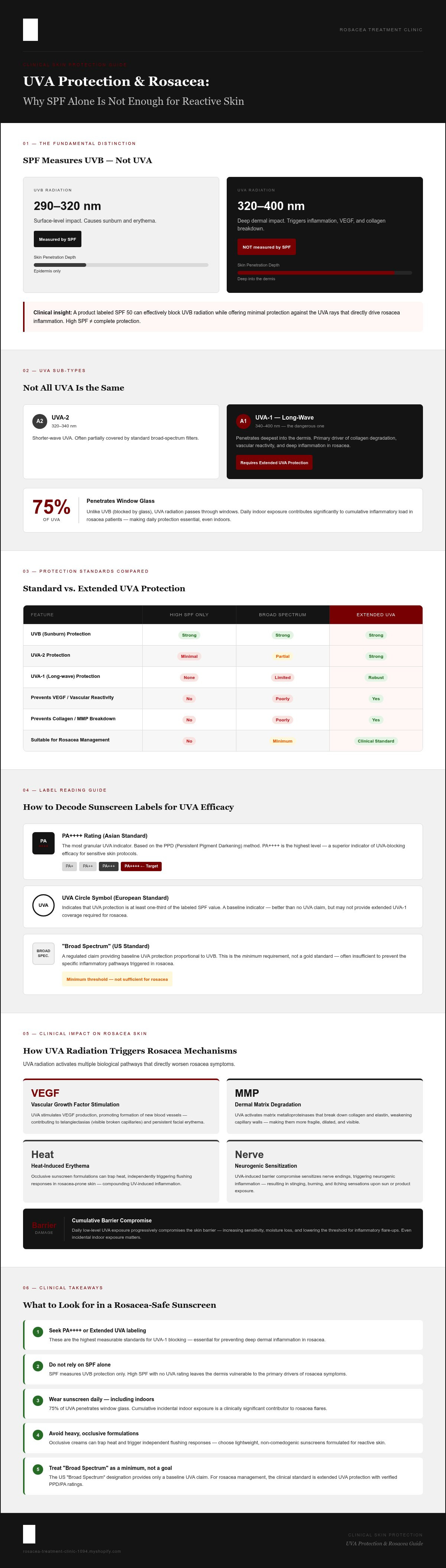
- Definition: UVB (290-320 nm) radiation is responsible for surface-level skin burns (erythema). UVA (320-400 nm) radiation penetrates into the dermis, causing cellular damage, photoaging, and inflammation.
- The limitation of SPF: The SPF number on a product primarily indicates its ability to block UVB rays. A product labeled SPF 50 effectively blocks UVB radiation but may offer minimal protection against the full spectrum of UVA rays.
- Broad Spectrum vs. Extended UVA: "Broad Spectrum" is a regulated term indicating that a sunscreen provides some UVA protection proportional to its UVB protection. However, for rosacea management, the clinical requirement is "Extended UVA Protection," a higher standard ensuring robust defense against the entire UVA spectrum, including long-wave UVA1.
- The role of the PPD (Persistent Pigment Darkening) scale: The PPD method is a system used to measure UVA protection. In Asia, this is often represented by the PA rating system (e.g., PA++++), which provides a clearer indication of UVA-blocking efficacy than the simple "Broad Spectrum" claim.
Wavelengths and Skin Penetration
The ultraviolet spectrum is not uniform. Understanding its components is essential for selecting an effective protective agent for reactive skin. UVA radiation is divided into two sub-types, both of which contribute to dermal damage.
- UVA-1 (340-400 nm) and UVA-2 (320-340 nm): UVA-1, or long-wave UVA, penetrates most deeply into the skin's dermal layer. It is a primary driver of photoaging and the degradation of collagen and elastin. For rosacea, its role in triggering deep inflammation is a major concern.
- How UVA radiation passes through window glass and cloud cover: Unlike UVB rays, which are largely blocked by glass, up to 75% of UVA radiation can penetrate windows. This makes daily, indoor protection a clinical necessity for managing rosacea, as incidental exposure contributes significantly to the cumulative inflammatory load.
- The cumulative effect of daily incidental UVA exposure on skin barrier function: Consistent, low-level UVA exposure compromises the skin's barrier, leading to increased sensitivity, moisture loss, and a lower threshold for inflammatory flare-ups.
Labeling Standards in 2026
Navigating sunscreen labels requires a precise understanding of international standards. As regulations evolve, recognizing the symbols of high efficacy becomes increasingly important for making clinically sound choices.
- Interpreting the UVA circle symbol and PA++++ ratings: The "UVA" in a circle is a European standard indicating that the UVA protection is at least one-third of the labeled SPF. The PA system, with PA++++ being the highest rating, offers a more granular measure of UVA defense and is considered a superior indicator for sensitive skin protocols.
- Why 'Broad Spectrum' is a minimum requirement, not a gold standard: The "Broad Spectrum" designation, particularly in the U.S., ensures a baseline level of UVA protection. However, this baseline is often insufficient to prevent the specific inflammatory pathways triggered in rosacea. For more information on this baseline, see our guide to Broad Spectrum Sunscreen UV Protection for Rosacea.
- UVA protection is the primary defense against photo-induced inflammation that drives rosacea symptoms.
The Clinical Impact of UVA Radiation on Rosacea and Reactive Skin
UVA radiation is not merely an environmental factor; it is a direct biological trigger for the core mechanisms of rosacea. Its effects extend far beyond visible tanning or aging, directly activating the cellular processes that lead to persistent redness, visible capillaries, and uncomfortable sensations of heat and stinging.
- UVA as a trigger for vascular endothelial growth factor (VEGF) in rosacea: UVA exposure stimulates the production of VEGF, a substance that promotes the formation of new blood vessels. In rosacea, this process contributes to the development of telangiectasias (visible broken capillaries) and persistent facial erythema.
- The mechanism of heat-induced erythema: Some sunscreen formulations, particularly heavy, occlusive creams, can trap heat in the skin. This elevation in temperature can independently trigger a flushing response in rosacea-prone individuals, compounding the inflammation caused by UV radiation itself.
*Dermal matrix degradation: UVA radiation activates enzymes called matrix metalloproteinases (MMPs), which break down collagen and elastin. This weakens the structural support of the skin and the tiny capillaries within it, making them more fragile and prone to dilation and visibility.
- The link between UVA exposure and the 'stinging' sensation in hyper-reactive skin: UVA-induced damage compromises the skin's barrier and sensitizes nerve endings. This can lead to neurogenic inflammation, where the skin overreacts to stimuli, resulting in the common stinging, burning, or itching sensations reported by patients upon product application or sun exposure.
Inflammatory Cascades and UV
At a microscopic level, UVA radiation initiates a chain reaction of inflammation. This process is central to the progression of rosacea and explains why effective filtration is non-negotiable for long-term management.
- How UVA radiation triggers pro-inflammatory cytokines in the skin: When UVA rays penetrate the dermis, they cause oxidative stress, leading skin cells to release pro-inflammatory messengers like cytokines and interleukins. These molecules signal for an inflammatory response, resulting in redness and swelling.
- The relationship between sun exposure and the 'flushing' response: The inflammatory response triggered by UVA includes the dilation of blood vessels. For individuals with rosacea, whose vascular regulation is already compromised, this leads to the pronounced and often prolonged flushing episodes that define the condition.
- Protecting the skin's innate immune response through high-level filtration: The skin has its own immune system. Chronic UVA exposure can dysregulate this system, contributing to the inflammatory state of rosacea. A high-protection sunscreen acts as a shield, allowing this system to function properly and the skin barrier to repair itself.
Ocular Rosacea and Sun Protection
The skin around the eyes is exceptionally thin and vulnerable, making it highly susceptible to UV damage and irritation from topical products. For those with ocular rosacea, proper sun protection is a critical component of managing symptoms.
- The sensitivity of the eye contour to standard chemical filters: Many common organic sunscreen filters can cause significant stinging, burning, and irritation when applied near the eyes, leading to poor compliance. This is a primary objection for many rosacea patients.
- Why UVA protection is critical for preventing ocular rosacea progression: UVA radiation can exacerbate the inflammation affecting the meibomian glands in the eyelids, worsening symptoms like dryness, grittiness, and redness of the eyes.
- Specialized formulations are required to provide protection without causing irritation. For guidance on products designed for this delicate area, see the Ocular Rosacea collection.
Comparing Standard Broad-Spectrum vs. Extended UVA Protection
The difference between a standard sunscreen and a clinical, high-protection formulation lies in its primary objective. One aims to prevent a sunburn, while the other is engineered to prevent a deep-seated inflammatory response. For rosacea management, only the latter is acceptable.
- Standard Sunscreens: Primarily formulated to achieve a high SPF rating, focusing on the prevention of acute erythema (sunburn) from UVB. Their UVA protection often only meets the minimum "Broad Spectrum" requirement.
- Extended UVA Formulations: Engineered with advanced filter systems to provide high-level, stable protection across the entire UVA spectrum, including long-wave UVA1. Their primary goal is the suppression of inflammation and the preservation of long-term dermal integrity.
- Physical vs. Chemical filters: The debate between mineral ("physical") and organic ("chemical") filters lacks nuance. While mineral filters are often well-tolerated, their UVA protection capabilities have limitations. Modern, stabilized organic filters are frequently superior for achieving high UVA-PF ratings in cosmetically elegant formulas.
- The importance of photostability: A sunscreen's effectiveness depends on its filters remaining stable upon exposure to UV light. Unstable filters can degrade in as little as 30 minutes, drastically reducing protection and potentially creating irritating byproducts. Extended UVA formulations prioritize photostable filters.
Filter Analysis for Sensitive Profiles
The selection of UV filters is the most critical factor in a sunscreen's performance and suitability for reactive skin. A common misconception is that all mineral filters provide superior protection.
- Zinc Oxide and Titanium Dioxide: These mineral filters are highly valued for their low potential for irritation, as they sit on the skin's surface. However, to provide high levels of UVA protection, they must be used in thick, opaque preparations that are often not cosmetically acceptable. Modern formulations use micronized or nano-sized particles for a more transparent finish however this process reduces their efficacy against long-wave UVA1 radiation.
- Modern organic filters: Advanced organic filters are specifically designed for high, photostable, broad-spectrum protection. They excel at absorbing long-wave UVA1 and are the cornerstone of clinical "Extended UVA Protection" sunscreens formulated for rosacea .
- Avoiding common irritants: For hyper-reactive skin, the absence of irritants is as important as the presence of effective filters. Formulations must be free of fragrance, denatured alcohol, and certain older, less stable organic filters (like un-stabilized avobenzone or oxybenzone) that are known to cause sensitization or stinging.
Performance in High-Reactive Environments
A superior sunscreen must perform not just in a lab but in the real-world conditions faced by individuals with rosacea, where heat, humidity, and environmental stressors can trigger flare-ups.
- How extended UVA protection reduces the frequency of 'random' flare-ups: Many flare-ups that seem to occur without a clear cause are often the result of cumulative, incidental UVA exposure. By effectively blocking this trigger, a high-protection sunscreen can dramatically improve skin stability and reduce the background level of inflammation.
- The role of antioxidants in boosting sunscreen efficacy: Antioxidants like Reprieve can help neutralize the free radicals generated by the small percentage of UV radiation that still penetrates the skin when using Attend. Reprieve provides a secondary layer of defense, reducing oxidative stress and supporting the sunscreen's primary function.
Selecting Sunscreens for Highly Sensitive Skin Protocols
Choosing a sunscreen for rosacea-prone skin is a clinical decision. It requires a systematic evaluation of the formula, from its active filters to its inactive ingredients and physical texture.
- Identify the primary filter system: Prioritize formulations built around modern, photostable organic shields for the highest degree of UVA protection. If choosing a mineral sunscreen for its low irritation potential, understand the potential trade-off in long-wave UVA coverage.
- Check for 'Extended UVA' or high PA ratings: Look beyond the "Broad Spectrum" claim. Seek out products that specify a high PA rating (PA+++ or PA++++) or use language indicating a focus on high UVA protection.
- Verify the absence of common triggers: Scrutinize the ingredient list for potential irritants. Ensure the product is explicitly labeled as fragrance-free and alcohol-free. Avoid filters like oxybenzone and PABA which have a higher association with contact dermatitis.
- Assess the vehicle: The base formula (the "vehicle") is critical for compliance and comfort. A lightweight fluid or emulsion is often better tolerated than a heavy, occlusive cream, as it is less likely to trap heat or clog pores.
- Test for ocular compatibility: Given the high prevalence of eye-area sensitivity, select sunscreens specifically tested for use around the eyes or formulated to minimize irritation and prevent disruption of the tear film.
The Rosacea Treatment Clinic Standards
Our formulations are developed to meet the specific demands of rosacea and hyper-reactive skin, prioritizing extended UVA protection, minimal irritation potential, and exceptional cosmetic elegance to ensure daily compliance.
- Introduction to Attend SPF 50: This formulation provides high-level, extended UVA and UVB protection within a sophisticated vehicle. It is engineered with advanced, photostable filters to shield against the inflammatory triggers that drive rosacea while maintaining a lightweight, non-greasy feel suitable for daily use.
- The De-sensitizing Barrier Fluid SPF 50: This product combines robust UV filtration with barrier-supporting ingredients. It is designed not only to protect the skin from external aggressors but also to help fortify its natural defenses, reducing underlying sensitivity over time.
- Why clinical formulations prioritize 'skin feel': Patient compliance is the most important factor in the success of any skincare protocol. If a sunscreen feels heavy, greasy, or irritating, it will not be used consistently. We prioritize lightweight, cosmetically elegant textures that integrate seamlessly into a daily routine.
Application Protocols for Maximum Efficacy
Proper application is just as crucial as product selection. Insufficient coverage or improper layering can compromise the effectiveness of even the most advanced sunscreen formulation.
- The 'Two-Finger Rule' for adequate facial coverage: To achieve the labeled SPF and UVA protection, a sufficient amount of product must be applied. A common guideline is to dispense sunscreen along the length of the index and middle fingers and apply this amount to the face and neck.
- Layering sunscreen over Hydrating Serum without pilling: Apply treatment serums to clean skin first and allow them to absorb completely for a minute or two. Then, apply sunscreen as the final layer. Pat or gently pressing the sunscreen into the skin.
- Re-application strategies for patients with active lifestyles: Sunscreen should be reapplied every two hours during continuous sun exposure, and more frequently after swimming, sweating, or towel drying. For incidental daily exposure (e.g., in an office setting), reapplication before periods of higher exposure (like a lunchtime walk) is recommended.
Integrating High-Protection Sunscreens into a Rosacea Management Plan
Sunscreen is not an isolated product but the cornerstone of a comprehensive, multi-step dermatological protocol for managing rosacea. It functions as the primary daytime shield that allows treatment and repair products to work effectively.
- Foundational Step: Cleansing: Begin with a gentle, non-stripping cleanser to remove impurities without compromising the skin barrier. The Anti-Inflammatory Foaming Cleanser is designed to calm the skin and prepare it for subsequent treatment steps.
- Treatment Step: Applying specialized serums: Apply targeted serums to address specific concerns like dehydration, redness, or barrier impairment. These products deliver active ingredients deep into the skin.
- Protection Step: The role of extended UVA shields: The final and most critical step in any daytime routine. A high-protection sunscreen locks in previous treatments and forms a defensive barrier against the primary environmental trigger of rosacea symptoms.
- Recovery Step: Nighttime repair: In the evening, after cleansing, use products focused on repair and regeneration, such as the Night Repair Cream, to support the skin's natural restorative processes while it is protected from UV exposure.
The Daily Defense Sequence
A consistent daily routine is fundamental to achieving long-term stability and resilience in rosacea-prone skin. The sequence should be logical, methodical, and non-negotiable.
- Morning protocol: Cleanse, hydrate, protect. This simple three-step process ensures the skin is clean, balanced, and shielded from environmental damage before the day begins.
- Managing mid-day heat: If the skin becomes hot or flushed during the day, a cooling lotion can be gently patted over sunscreen to provide relief without disturbing the protective film.
- Consistent, daily UV protection is the single most critical step in any effective rosacea treatment protocol.
Long-term Dermal Restoration
The benefits of diligent sun protection extend beyond preventing immediate flare-ups. It is a long-term investment in the structural health and integrity of the skin.
- How consistent UVA protection allows the skin barrier to repair itself: By shielding the skin from the constant inflammatory pressure of UVA radiation, the skin's own repair mechanisms can function optimally. Over time, this leads to a stronger, more resilient skin barrier with reduced sensitivity.
- Reducing the need for corrective procedures through preventative care: Proactive, daily protection can slow the progression of rosacea symptoms like telangiectasias and persistent erythema, potentially reducing the future need for more intensive clinical interventions.
- CTA: Explore the complete range of clinical sunscreens and protocols.
Frequently Asked Questions (FAQs)
Is SPF 50 enough for rosacea if it doesn't specify UVA protection?
No. SPF 50 indicates a high level of protection against UVB rays (sunburn) but provides no guarantee of sufficient protection against inflammatory UVA rays. For rosacea, you must look for "Broad Spectrum" paired with a high PA rating (e.g., PA++++) or other indicators of high, extended UVA protection.
Why does my sunscreen sting my eyes and face?
Stinging can be caused by several factors, including certain UV filters, alcohol or fragrances and overall formulation. It can also be a sign of a compromised skin barrier that is hyper-reactive to many ingredients. Selecting sunscreens specifically formulated and tested for sensitive, rosacea-prone skin is essential to avoid stinging.
Can I use a physical and chemical sunscreen together for better UVA protection?
Layering different sunscreens is generally not recommended as the formulas may interact in unpredictable ways, potentially destabilizing the filters and reducing overall efficacy. It is better to choose a single, well-formulated product with a combination of modern, photostable filters that provide proven high UVA protection.
How often should I reapply sunscreen if I have rosacea?
Reapply every two hours when outdoors, or more often if you are swimming or sweating heavily. For typical indoor days with incidental exposure, one thorough application in the morning may be sufficient, but reapplication is wise before any planned sun exposure, such as a walk during a lunch break.
Does UVA protection help with facial redness and flushing?
Yes, absolutely. UVA radiation is a primary trigger for the inflammation and vascular dilation that cause redness and flushing in rosacea. By consistently blocking UVA, you can significantly reduce the frequency and intensity of these symptoms and calm the skin over time.
What is the difference between PA++++ and SPF ratings?
SPF (Sun Protection Factor) measures the level of protection against UVB radiation. The PA (Protection Grade of UVA) system, used in Japan and other parts of Asia, measures protection against UVA radiation. PA++++ is the highest possible rating, indicating extremely high UVA protection, making it a valuable indicator for those with rosacea.
Should I wear sunscreen indoors to protect against UVA?
Yes. UVA rays can penetrate window glass, meaning you are exposed while driving, sitting near a window at home, or in an office. For rosacea management, daily sunscreen application is a non-negotiable step, regardless of whether you plan to spend time outdoors.
Is mineral sunscreen better than chemical sunscreen for reactive skin?
Mineral sunscreens (zinc oxide, titanium dioxide) are often well-tolerated due to their inert nature, making them a safe choice for extremely sensitive skin. However, their UVA protection, particularly against long-wave UVA1, is limited in cosmetically elegant, non-opaque formulas. Modern organic ("chemical") sunscreens with advanced filters can provide superior, more robust, and more stable UVA protection, which is the primary objective for rosacea management.