
The 2026 FDA updates to sunscreen regulations fundamentally changed the evaluation of UV protection for sensitive skin. A standard broad spectrum sunscreen example, such as those utilizing the newly approved filter bemotrizinol, must now adhere to stricter administrative orders to ensure efficacy against both UVA and UVB rays. If you have experienced the stinging or heat-trapping effects common with traditional formulations, you know that finding a product that doesn't trigger a flare is a medical necessity rather than a cosmetic preference.
We recognize that managing vascular dilation requires more than just high SPF. This article identifies specific broad spectrum sunscreen examples that meet the rigorous 2026 clinical standards for rosacea-prone skin while avoiding common irritants. You'll gain a clear understanding of UV protection benchmarks and the importance of high extended UVA protection . We also provide a structured daily defense protocol featuring specialized interventions like the Antioxidant Radiance Defence Shield to help you maintain a calm, resilient complexion.
Key Takeaways
- Understand the regulatory requirements for a broad spectrum sunscreen example, specifically the "Critical Wavelength" test for balanced UVA and UVB defense.
- Analyze the biological mechanism where UV radiation triggers inflammatory cytokines and cathelicidins, resulting in chronic facial flushing and vasodilation.
- Identify specific sunscreens suitable for rosacea.
- Implement a methodical treatment sequence that integrates barrier repair fluids with UV protection to manage skin sensitivity effectively.
- Evaluate the clinical necessity of High Extended UVA Protection for addressing the deeper vascular damage associated with chronic inflammatory skin conditions.
Understanding the Definition of Broad Spectrum Sunscreen
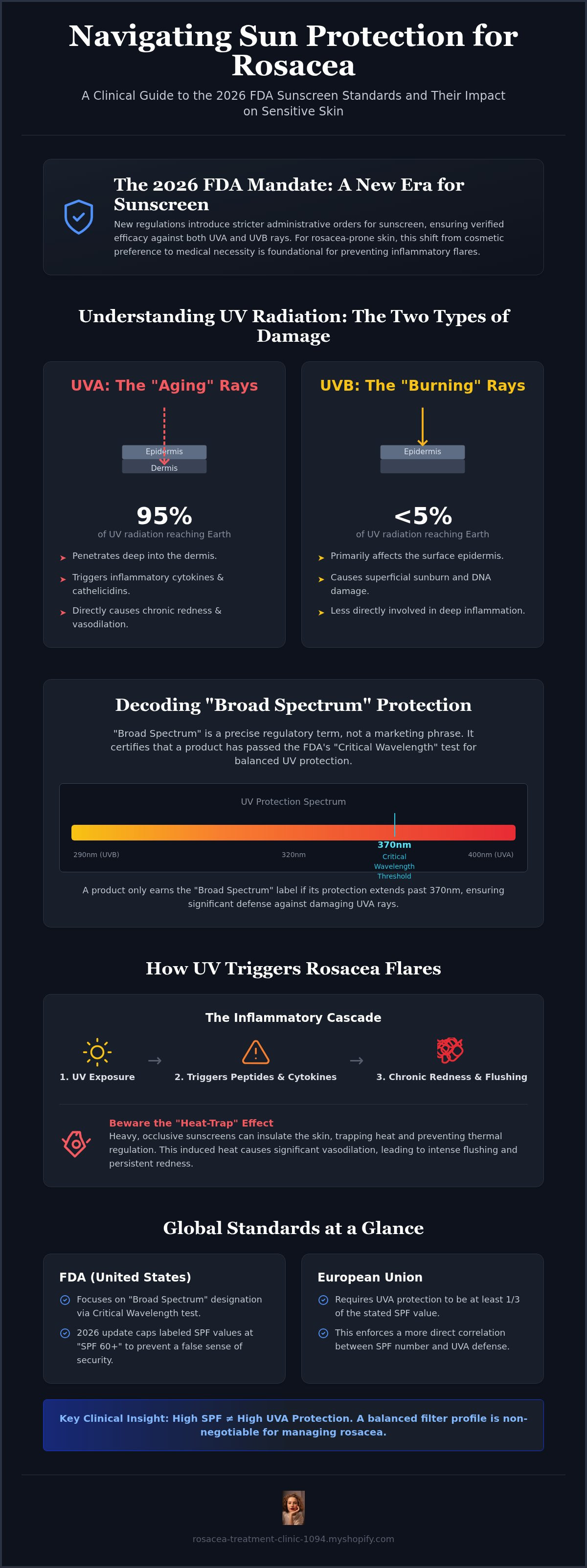
Broad spectrum is a precise regulatory designation rather than a descriptive marketing phrase. It indicates that a formulation provides balanced protection against both Ultraviolet A (UVA) and Ultraviolet B (UVB) radiation. For a product to qualify as a valid broad spectrum sunscreen example, it must pass the "Critical Wavelength" test. This clinical assessment measures the breadth of UV protection across the spectrum. A formulation only receives the designation if its protection extends to at least 370 nanometers, ensuring the filter doesn't just block short-wave UVB but also a significant portion of the UVA range.
The 2026 FDA updates have introduced stricter safety standards and labeling requirements to improve consumer transparency. These changes require all products with the broad spectrum label to provide clear protection against skin aging and cancer risks. For individuals managing rosacea, these standards are foundational.
Without verified broad spectrum coverage, a sunscreen may prevent a surface burn while allowing deeper UVA rays to penetrate the dermis and trigger inflammatory cascades.
The Difference Between UVA and UVB Rays
UV radiation is categorized by wavelength and biological impact.
UVA rays (320 to 400 nm) account for approximately 95% of the UV radiation reaching the Earth's surface. These "Aging" rays penetrate into the deeper dermal layers, where they trigger the release of cathelicidins and inflammatory cytokines. For those with rosacea, this process directly leads to chronic redness and vasodilation.
UVB rays (290 to 320 nm) are the "Burning" rays. They primarily affect the epidermis, causing surface damage and DNA mutations.
While UVC rays are high-energy, they're currently absorbed by the ozone layer and don't require topical intervention.
A comprehensive broad spectrum sunscreen example must address the specific inflammatory potential of UVA to be effective for sensitive skin.
Regulatory Standards for Sun Protection
Global regulatory bodies maintain different benchmarks for UV defense. The FDA focuses on the broad spectrum designation and the Critical Wavelength test. In contrast, EU standards often require a UVA protection factor that's at least one-third of the stated SPF. In 2026, the FDA has also capped labeled SPF values at "SPF 60+" to prevent a false sense of security. It's a clinical reality that a high SPF doesn't always guarantee high UVA defense.
A formulation might have an SPF of 50 but still possess insufficient UVA coverage if the filter profile isn't optimized.
For specialized care, clinicians look for High Extended UVA Protection to ensure the most damaging long-wave rays are effectively neutralized.
The Impact of UV Radiation on Rosacea-Prone Skin Barriers
UV radiation acts as a potent biological catalyst in rosacea-prone skin. It triggers the abnormal release of cathelicidins, specifically LL-37 peptides, and pro-inflammatory cytokines. This immune response isn't localized to the surface; it penetrates deeper, leading to the recruitment of inflammatory cells that exacerbate chronic redness. When these pathways are activated, the skin's defense mechanisms become compromised, turning a temporary environmental stressor into a persistent inflammatory state.
Many patients find that applying a standard broad spectrum sunscreen example causes an immediate increase in facial temperature.
This "Heat-Trap" effect occurs when occlusive, heavy formulations insulate the skin, preventing natural thermal regulation. For a rosacea patient, this trapped heat induces significant vasodilation, which manifests as intense flushing and persistent telangiectasia. Choosing a formulation that facilitates heat dissipation while maintaining a robust UV filter is essential for long-term management.
Following established Clinical Protocols for Daily UV Defense ensures that the application method supports the protective efficacy of the chosen formulation without inducing thermal stress.
UV as a Primary Rosacea Trigger
Solar radiation is the most frequent environmental trigger for rosacea flares. UV exposure stimulates vascular endothelial growth factor (VEGF), which promotes the growth of new, fragile blood vessels.
Unlike a standard sunburn, which typically resolves within a few days, a rosacea flare triggered by even 10 minutes of unprotected exposure can cause a systemic inflammatory response lasting a week or longer.
Differentiating between these two states is vital; while a sunburn is a thermal injury, a rosacea flare is a complex vascular and neurological reaction.
Identifying a suitable broad spectrum sunscreen example that uses non-irritating formulation can prevent these rapid-onset flares.
Secondary Inflammation and Reactive Oxygen Species (ROS)
UV rays generate reactive oxygen species (ROS) that overwhelm the skin's natural antioxidant defenses . These free radicals attack lipids in the skin barrier, leading to structural degradation and increased transepidermal water loss. This barrier breakdown is often the precursor to the chronic sensitivity and stinging associated with the condition. Integrating clinical-grade antioxidants alongside broad spectrum filters is necessary to neutralize these unstable molecules before they cause permanent cellular damage. Oxidative stress in rosacea-prone skin represents a pathological imbalance where the accumulation of reactive oxygen species exceeds the tissue's capacity to neutralize them resulting in cellular damage and chronic inflammatory signaling.
Exploring specialized treatment collections can help you identify products designed to support the skin barrier and neutralize inflammation during UV exposure.
Characteristics and Examples of Broad Spectrum Sunscreen Formulations
Clinical sunscreen selection for inflammatory skin requires a precise understanding of filter morphology and vehicle dynamics. We categorize UV filters into two primary groups: physical (mineral) and chemical (organic). While mass-market formulations often prioritize cost or shelf-life, a professional broad spectrum sunscreen example must utilize high-purity ingredients that maintain stability without inducing thermal stress or chemical irritation. The evolution of these formulations has moved away from the thick, occlusive pastes of the past toward sophisticated, non-whitening near-weightless barriers that respect the skin's need for "respiration."
For individuals with rosacea zinc and titanium dioxide are sources of insufficient protection and frequently discrete contact dermatitis. Synthetic fragrances are a primary source of contact dermatitis, while denatured alcohols can strip the lipid barrier, leading to immediate stinging. A clinical broad spectrum sunscreen example should instead focus on carriers that deliver active filters while simultaneously soothing the epidermal surface. This methodical approach ensures that UV defense does not come at the cost of increased skin sensitivity.
Physical vs. Other Filter Examples
Physical filters, specifically Zinc Oxide and Titanium Dioxide, remain popular for reactive skin however provide relatively inferior protection under real-world usage conditions. Particularly in more comfortable however less efficacious smaller particle sizes both zinc and titanium are associated with paradoxical skin reactions. If zinc is to be used it should be in combination with titanium dioxide. Modern filters, such as Tinosorb (bemotrizinol), have challenged the myth that organic filters cause stinging. These large-molecule filters do not penetrate the skin easily, offer high photostability and can be employed to reduce inflammation.
Texture and Vehicle Selection
The vehicle, or the base in which filters are suspended, determines how the skin manages heat. Heavy, occlusive creams often create a "Heat-Trap" effect, which insulates the skin and triggers vascular flushing. For rosacea management, lightweight fluids and de-sensitizing emulsions are superior. These vehicles facilitate heat dissipation, keeping the facial temperature stable even during sun exposure. A primary clinical vehicle example is the De-Sensitizing Barrier Fluid SPF 50. This formulation utilizes a specialized delivery system that reinforces the skin's natural moisture barrier while providing the high-level UV protection required for chronic redness. By choosing fluids that mimic the skin's natural lipid structure we ensure that the sunscreen remains a protective intervention rather than a trigger for inflammation.
Clinical Protocols for Daily UV Defense and Reapplication
A clinical defense strategy against UV radiation requires more than the selection of a high-quality filter; it necessitates a methodical application protocol. For any broad spectrum sunscreen example to perform at its tested SPF and UVA protection factor, users must apply a standardized dosage. The "Two-Finger Rule" remains the clinical benchmark for facial coverage, ensuring approximately 2mg of product per square centimeter of skin. Insufficient application significantly degrades the protective barrier, leaving the skin vulnerable to the inflammatory cascades and vascular dilation discussed in previous sections.
Incidental exposure represents a significant risk factor for chronic flushing and telangiectasia. UVA radiation maintains high intensity throughout daylight hours and penetrates standard window glass. Drivers and individuals working in proximity to windows remain susceptible to deeper dermal damage without a consistent shield. Maintaining this barrier throughout the day is essential, though reapplying over reactive or made-up skin requires a precise approach. Patting a lightweight fluid over the face rather than using aggressive rubbing motions prevents the mechanical friction that often triggers a flare in sensitive skin types.
A Morning Protection Sequence
Establishing a structured morning sequence ensures the skin is desensitized and hydrated before UV exposure. This layering protocol follows a logical progression from foundational cleansing to specialized intervention. Step 1: Begin with Anti-Inflammatory Foaming Cleanser to remove nocturnal debris without stripping the lipid barrier. Step 2: Apply Hydrating Serum to lock in moisture and provide a soothing foundation. Step 3: Seal the protocol with a dedicated broad spectrum shield, such as Attend SPF 50, to provide a resilient barrier against solar radiation.
Environmental Management Beyond Sunscreen
Topical protection should be integrated into a broader environmental management plan to minimize inflammatory triggers. Seeking shade and utilizing wide-brimmed hats during peak UV hours, typically between 10 AM and 4 PM, reduces the total photon load on the skin. Following exposure, users can apply Cooling Stress Lotion to rapidly mitigate residual heat and calm the vascular response. Ocular rosacea also requires specialized care; UV-rated eyewear protects the delicate eye area, while Ocular Conditioning Cleanser ensures the lid margins remain free from environmental irritants that can exacerbate redness and irritation.
To build a comprehensive defense system tailored to your skin's needs, explore our specialized rosacea treatment collections.
Specialized Solutions: High Extended UVA Protection for Chronic Redness
While a standard broad spectrum sunscreen example meets regulatory baselines, it often lacks the high-titer UVA defense required for pathological redness.
High Extended UVA Protection (KD) represents a superior clinical standard designed specifically for inflammatory skin. This intervention targets the long-wave UVA spectrum that penetrates deep into the dermis, where it induces structural damage to the vascular walls. For patients with chronic rosacea, neutralizing these specific wavelengths is essential to prevent the progression of telangiectasia and permanent facial flushing.
The Rosacea Treatment Clinic protocols serve as a methodical bridge between professional dermatology and daily self-care.
By utilizing filters that extend protection beyond the standard 370nm critical wavelength, we address the root causes of UV-induced vascular growth factors.
This specialized approach ensures that the defense system remains effective against the deeper biological triggers that standard mass-market formulations often overlook.
It's a shift from basic sun protection to a targeted therapeutic intervention that respects the unique hemodynamics of sensitive skin.
Why Standard SPF 50 is Often Insufficient
The "UVA Gap" refers to the significant amount of long-wave solar radiation that bypasses standard filters. Even a formulation labeled SPF 50 may provide insufficient defense against the specific rays that trigger dermal inflammation. For individuals with visible blood vessels or persistent redness, high-titer UVA protection is a clinical necessity. Standard tests don't always account for the cumulative vascular impact of long-wave UVA, which remains consistent throughout the year. You can find specialized formulations designed to close this gap in our Sunscreens Collection, which prioritizes extended spectral coverage over simple SPF values.
Integrating Barrier Repair with UV Defense
A compromised epidermal barrier increases the skin's susceptibility to UV-induced damage, creating a cycle of chronic sensitivity. UV radiation degrades the lipid matrix, making it harder for the skin to maintain hydration and resist environmental triggers. Integrating barrier repair ingredients, such as ceramides and fatty acids, directly into the protection sequence restores the skin's natural resilience. We recommend combining your UV shield with the Original Repair Treatment Fluid or Night Repair Cream for 24-hour support. This combination ensures that while the sunscreen neutralizes incoming photons, the repair fluid actively restores the structural integrity of the barrier. This comprehensive, non-prescription protocol provides the methodical defense necessary for long-term rosacea management and the reduction of chronic inflammatory signaling.
By addressing both the external trigger and the internal barrier weakness, you create a stable environment for the skin to recover and maintain its calm, uniform tone.
Implementing Methodical UV Defense
Effective rosacea management requires moving beyond generic SPF claims toward specialized, research-based interventions. We've established that while a standard broad spectrum sunscreen example meets regulatory critical wavelength tests, it doesn't always address the deeper vascular damage caused by long-wave UVA.
Since 1996, the Rosacea Treatment Clinic has developed non-stinging, anti-inflammatory protocols that prioritize high extended UVA protection and systematic barrier restoration.
Integrating these clinical sunscreens with repair fluids ensures your skin remains resilient against environmental triggers and the detrimental heat-trap effect. By following a structured daily protocol, you can effectively manage redness and prevent the inflammatory cascades associated with solar exposure. Consistent application of these specialized shields represents the most reliable defense against progressive telangiectasia and chronic sensitivity.
Explore Clinical Broad Spectrum Sunscreens for Rosacea to access dermatological defense systems designed for sensitive skin. With the right clinical shield, maintaining a calm and uniform complexion is a predictable outcome of methodical care.
Frequently Asked Questions
What is a good broad spectrum sunscreen example for rosacea?
Formulations that meet High Extended UVA Protection standards to address deep dermal inflammation and vascular triggers such as Attend SPF 50+ are optimal. Unless opaque zinc and titanium sunscreens allow considerable UVA to penetrate.
Does broad spectrum sunscreen protect against both UVA and UVB?
Yes, the broad spectrum designation confirms that a product protects against both UVA and UVB radiation. To receive this label, the formulation must pass the "Critical Wavelength" test, ensuring protection extends to at least 370 nanometers. This balance is vital for rosacea patients because UVA triggers inflammatory cytokines while UVB rays cause surface burning and DNA damage.
Why does my broad spectrum sunscreen sting my eyes?
Ocular stinging typically results from the migration of volatile ingredients or unstable chemical filters into the eye area. Fragrances, denatured alcohols, and older organic filters like oxybenzone are common culprits. Using a specialised sunscreen prevents this migration and supports the management of ocular rosacea without causing localized irritation.
Is SPF 30 broad spectrum enough for sensitive skin?
SPF 30 is the minimum regulatory baseline for daily protection, but reactive skin often requires higher tiers. Clinical protocols frequently favor SPF 50 for rosacea-prone individuals because UVA protection is often proportionally linked to the SPF value. A higher SPF ensures a more robust shield against the specific long-wave rays that stimulate vascular growth factors and chronic flushing.
Can I use a chemical broad spectrum sunscreen if I have rosacea?
You can utilize modern chemical filters if they're photostable and non-penetrative. Large-molecule filters like bemotrizinol are excellent options because they don't easily cross the skin barrier. However, we generally advise avoiding older chemical filters that are known to cause localized stinging or systemic absorption in reactive skin types.
What is the difference between broad spectrum and full spectrum sunscreen?
Broad spectrum is a regulated clinical term focusing on UVA and UVB defense. Full spectrum is a broader, often unregulated marketing label that may imply protection against infrared radiation and high-energy visible blue light. For medical-grade rosacea care, the broad spectrum designation and the specific UVA protection factor remain the primary clinical benchmarks for preventing inflammatory flares.
How often should I reapply sunscreen if I am indoors most of the day?
Reapplication is required every two hours if you're exposed to incidental UV radiation through windows. UVA rays penetrate standard glass and remain consistent in intensity throughout daylight hours. If you're in a windowless environment, a single morning application is often sufficient, provided the skin barrier remains undisturbed by significant perspiration or mechanical friction during the day.
Does broad spectrum sunscreen prevent facial redness and flushing?
Sunscreen effectively prevents UV-induced redness by neutralizing the photons that trigger inflammatory signaling. It doesn't instantly resolve existing flushing, but it halts the cycle of vascular dilation caused by solar exposure. For optimal results, UV defense must be paired with barrier repair fluids to stabilize the skin's reactive threshold and manage chronic inflammatory signaling over time.