
The SPF 50 rating on your bottle might be the primary reason your skin continues to flush. While 81% of patients identify sun exposure as their leading trigger many find that religious application of a standard sunscreen for rosacea fails to prevent chronic inflammation. You will likely recognize the clinical frustrations of ocular stinging from volatile chemical filters or the heat trapping associated with heavy, occlusive mineral pastes. These reactions are not just inconvenient; they indicate a systematic failure in your protective barrier's defense system.
This analysis demonstrates why traditional SPF metrics are insufficient for managing sensitive skin phenotypes. We examine the technical requirement for high-extended UVA protection to mitigate deep-tissue damage and dermal remodeling. You will discover how to identify photostable filters, including the recently FDA-approved bemotrizinol, that provide defense without inducing heat-related flares. This guide provides a methodical protocol for a non-irritating daily defense system that prioritizes long-term skin stability over mere burn prevention. By shifting focus toward advanced UVA filtration you can finally move beyond reactive cooling and toward proactive dermal restoration.
Key Takeaways
- Distinguish between UVB-focused SPF and high-extended UVA defense to prevent deep-tissue dermal remodeling and chronic flushing.
- Identify clinical-grade protection using technical benchmarks, specifically a Critical Wavelength exceeding 370nm and a PA++++ rating.
- Navigate the selection process for a specialized sunscreen for rosacea by evaluating the trade-offs between mass-market formulas and clinical barrier fluids.
- Adopt a methodical application protocol that integrates desensitizing serums to neutralize heat-induced vascular endothelial growth factor (VEGF) triggers.
- Review the therapeutic advantages of modern filters such as bemotrizinol, which offer superior photostability for highly reactive skin profiles.
The Critical Distinction Between SPF and High Extended UVA Protection
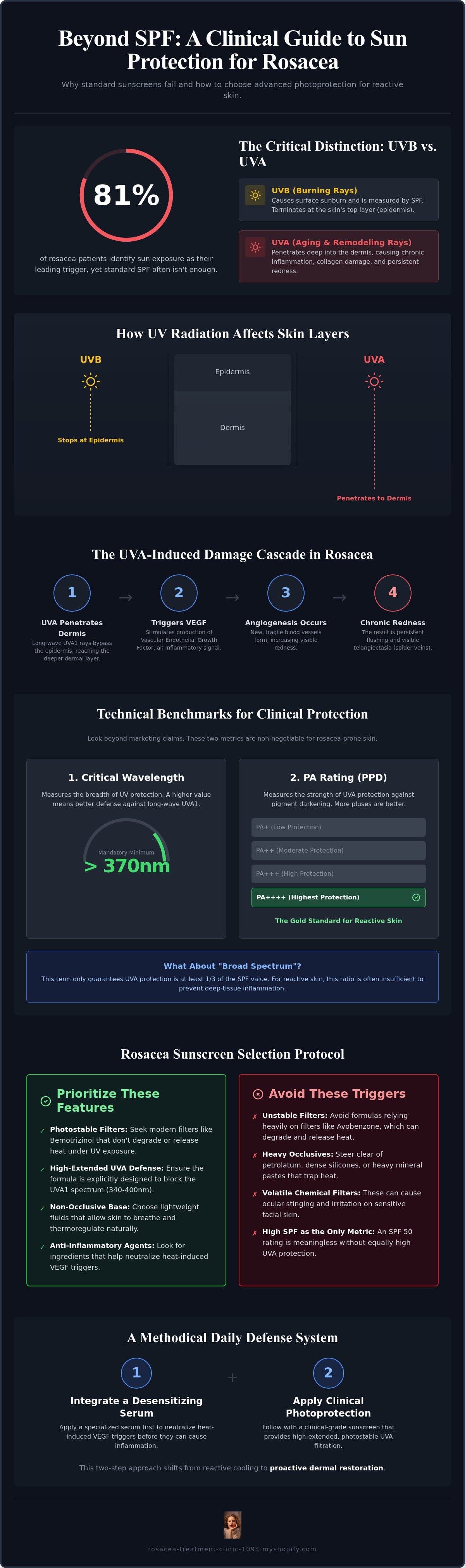
The SPF rating on a product label is a specific metric of UVB protection. It quantifies how long a topical application prevents the onset of erythema, or surface sunburn, compared to unprotected skin. For a standard patient an SPF 50 rating suggests high-level defense. However, for those managing Rosacea, SPF alone is an incomplete diagnostic for skin safety. While UVB radiation terminates at the epidermal layer, UVA wavelengths penetrate the deeper dermis where they catalyze the production of vascular endothelial growth factor (VEGF).
VEGF is a signalling protein that stimulates angiogenesis (the formation of new, fragile blood vessels). This process directly contributes to the persistent redness and visible telangiectasia characteristic of the condition. Many individuals experience heat-induced flares despite using a high-SPF sunscreen for rosacea because their product lacks sufficient filtration in the UVA1 range. Standard filters often fail to mitigate the deep-tissue inflammation that drives vascular expansion.
UVB vs. UVA: The Dermal Remodeling Process
UVB rays are energetic but short. They cause immediate DNA damage to surface cells. In contrast, UVA rays are present with consistent intensity throughout the year and penetrate through clouds and glass. These longer wavelengths generate reactive oxygen species (ROS) that degrade the structural integrity of collagen and elastin fibres. This dermal remodeling weakens the support structures surrounding facial capillaries leading to permanent dilation and increased reactivity.
The "Broad Spectrum" label is often misinterpreted as a clinical gold standard. In regulatory terms it simply means the UVA protection is at least one-third of the stated SPF. For reactive skin this ratio is frequently insufficient. A specialized sunscreen for rosacea must prioritize an "Extended UVA" defense system to neutralize the radiation responsible for chronic vascular instability.
The Role of Long-Wave UVA1 in Rosacea Pathogenesis
The UVA spectrum is divided into UVA2 (320–340nm) and UVA1 (340–400nm). UVA1 accounts for approximately 75% of the total UV radiation reaching the earth's surface. It is the primary driver of deep-seated inflammation. When UVA1 reaches the dermis, it triggers the release of inflammatory cytokines, such as interleukin-1 and interleukin-6, which exacerbate the skin's sensitivity and heat response.
Effective management requires photostable filters that do not degrade or release thermal energy during peak exposure. Modern formulations must maintain their protective integrity to prevent the "heat trapping" effect common in low-grade chemical filters. For a technical breakdown of how to select these filters, consult the high UVA protection sunscreens rosacea buying guide.
True defense is not found in a high SPF number alone but in the breadth and stability of the UVA1 filtration system.
Technical Criteria for Selecting a Clinical Rosacea Sunscreen
Selecting a clinical sunscreen for rosacea requires an objective analysis of technical specifications rather than aesthetic marketing. The primary benchmark for breadth of protection is the Critical Wavelength. A value of 370nm or higher is mandatory to ensure the formula covers the extended UVA1 spectrum. Without this specific breadth the skin remains vulnerable to the deep-tissue triggers that drive vascular expansion. Additionally, the PA (Protection Grade of UVA) system provides a standardized measure of persistent pigment darkening (PPD). A PA++++ rating indicates a PFA of 16 or greater, representing the highest tier of available UVA defense.
Filter stability is equally vital. When unstable filters like Avobenzone degrade under UV exposure, they often release thermal energy. This process induces the very flushing the patient intends to prevent. Formulations must also avoid heavy occlusives like petrolatum or dense silicones. These ingredients create a "heat-trapping" effect by preventing natural cutaneous thermoregulation. For a detailed breakdown of these technical requirements, review our UVA protection guide for reactive and rosacea skin. Adhering to National Rosacea Society guidelines ensures a baseline of safety, yet clinical management requires moving beyond general recommendations toward specialized filtration.
Evaluating Filter Types: Physical vs. Advanced Chemical
Micronized Zinc Oxide is frequently cited for its broad-spectrum capabilities. It offers excellent efficacy in the UVA1 spectrum while maintaining a low irritation profile. However, mineral-only formulas struggle to reach high-extended UVA benchmarks without becoming overly thick or whitening. This has led to the development of hybrid formulations. These utilize modern, non-irritating organic filters like bemotrizinol, which the FDA approved on June 9, 2026. These advanced filters provide superior photostability and a lightweight finish that does not compromise the skin's thermal balance.
Identifying Potential Irritants in Standard Formulations
Standard sunscreen for rosacea often utilizes older chemical filters that cause a distinct "sting factor" upon application. Octinoxate and Oxybenzone are primary culprits as they can penetrate the compromised barrier of reactive skin and trigger neurogenic inflammation. You should also audit your labels for fragrance and high concentrations of volatile chemicals. These are common triggers for barrier disruption and immediate stinging. A hypoallergenic dermatological preservative system is essential. Choosing formulas with high dermatological tolerance ensures the protective layer does not become a source of irritation. You can find these specialised requirements addressed within our comprehensive clinical collections.
Comparing Photoprotection Frameworks: A Buying Guide
Evaluating the market for a sunscreen for rosacea involves distinguishing between mass-market, cosmetic, and clinical frameworks. Standard drugstore SPF products offer high accessibility and cost-efficiency. However, these formulas often prioritize UVB burn prevention over UVA1 breadth, leaving the deeper dermis vulnerable to vascular triggers. In contrast, 'beauty' sunscreens emphasize cosmetic elegance and a weightless feel. They frequently achieve this through high concentrations of volatile alcohols or fragrance, which compromise the skin barrier and induce stinging.
Clinical protocols represent a specialized tier. These systems integrate photo-protection with barrier restoration and high-extended UVA defense. While efficacy is the priority, cosmetic elegance remains essential for patient compliance. If a formula is aesthetically unpleasant users will not apply the required therapeutic amount. A methodical selection process balances technical filtration with a finish that supports the skin's daily thermoregulation. This ensures the defense system remains intact throughout the day without inducing reactive flushing.
The Mineral vs. Hybrid Debate for Rosacea
Traditional clinical advice often favors 100% mineral barriers. Zinc oxide and titanium dioxide are inert and provide good safety profiles for sensitive phenotypes. The primary limitations include a persistent white cast and a heavy, chalky texture accompanying adequate protection that can be difficult to layer. Advanced hybrid formulas solve these issues. By combining micronized modern filters these systems achieve superior UVA-PF ratings without clinical irritation. For those with erythematotelangiectatic rosacea iron oxides are a critical addition. These pigments provide a defense against visible light, which is known to exacerbate facial redness. The high UVA protection sunscreens rosacea buying guide provides further detail on these specific ingredient synergies.
Texture and Finish: Managing the 'Mask' Effect
The delivery system of a sunscreen for rosacea is as important as the filters. Heavy, occlusive creams can create a 'mask' effect. This layer traps cutaneous heat against the skin, triggering a vasodilation response and subsequent flushing. Clinical settings generally favour fluid-based or emulsion-style deliveries. These lightweight structures allow the skin to breathe while maintaining a protective shield. Patients with erythematous subtypes often prefer 'dry-touch' finishes to minimize the sensation of heat. Those with papulopustular presentations may benefit from dewy, hydrating emulsions that support barrier repair. You can explore these delivery options in our specialized sunscreen collection.
Clinical Application Protocol for Reactive Skin
Managing a sunscreen for rosacea requires more than just application; it necessitates a methodical sequence to ensure barrier stability. A clinical protocol begins with foundational cleansing to remove overnight inflammatory byproducts. This is followed by a desensitizing serum designed to stabilize the vascular response. Once the skin is calm, you apply High Extended UVA Protection. For sustained defense, strategic reapplication is required throughout the day, ensuring the barrier remains intact without inducing cumulative irritation.
The timing of application is a technical factor. Clinical filters require a stabilized surface to form a uniform protective film. If the skin is actively flushing or overheating during application the efficacy of the barrier is compromised. Following a structured four-step process ensures the defensive layer functions as intended without triggering neurogenic inflammation.
- Cleansing: Neutralize surface heat and remove cellular debris.
- Stabilization: Apply a vascular-calming agent to reduce reactivity.
- Protection: Layer the extended UVA filter using gentle, outward motions.
- Maintenance: Reapply every 2 to 4 hours during peak exposure using lightweight fluids.
Pre-Application Barrier Preparation
Surface heat is a significant trigger for neurogenic inflammation. Utilizing an Anti-Inflammatory Foaming Cleanser in the morning reduces this baseline heat and prepares the skin for topical filters. If you apply sunscreen to a compromised or dehydrated barrier the active filters often migrate into the dermal layers, leading to immediate stinging. Creating a moisture reservoir is essential. Applying a Hydrating Serum before your sunscreen provides a protective buffer, ensuring the photo-protective layer sits on a stabilized surface rather than an inflamed one.
Removal Protocols to Prevent Flare-ups
Removing high-adhesion filters at the end of the day is a critical yet often overlooked step. Residual filters can trap sweat and bacteria, leading to late-evening flares. However, aggressive scrubbing or the use of harsh surfactants will strip the lipid barrier. A clinical removal protocol avoids traditional double cleansing with volatile oils. Instead, use Pre-Cleansing Emulsifier for PM removal. This ensures thorough removal of all sunscreen for rosacea residues while simultaneously restoring the acid mantle. Following this structured protocol transforms photo-protection from a source of irritation into a reliable defense system. You can explore the full range of barrier-safe formulations in our clinical skincare collections.
The Rosacea Treatment Clinic Specialized Photoprotection
The Rosacea Treatment Clinic provides research-based, dermatological protocols derived from Spectrum Analytical Laboratory research. Our sunscreens are engineered to surpass mass-market standards by prioritizing high-extended UVA protection and desensitizing properties. Unlike generic commercial offerings that focus on broad consumer appeal the formulations address the specific physiological requirements of reactive, erythematous skin. Every product is a component of a larger, methodical treatment system designed to restore dermal stability.
We emphasise the integration of repair mechanisms within the photo-protection layer. This dual-action approach ensures that the skin is not just shielded from incoming radiation but is also actively recovering from baseline inflammation.
By utilizing specialized sunscreen for rosacea, patients can maintain a consistent defense system that resists the typical triggers of heat and chemical irritation.
Our commitment to specialized knowledge ensures that each formula provides a clinical advantage over standard drugstore options.
Attend SPF 50: Specialized UVA Defense
Attend SPF 50 utilizes a sophisticated fluid delivery system. This lightweight texture is critical for minimizing friction during application which prevents the mechanical induction of flushing. The formula incorporates a high-concentration antioxidant complex to neutralize UVA-induced free radicals before they can trigger deep-tissue damage. This product is a foundational element within our New Tone Harmonizing Protocol. It provides a photostable shield that supports long-term pigment and vascular correction.
Key technical features of Attend SPF 50 include:
- High-extended UVA filtration targeting the 340 to 400nm spectrum.
- Non-occlusive fluid delivery to support cutaneous thermoregulation.
- Photostable filters that resist thermal degradation during peak UV exposure.
- Antioxidant fortification to mitigate oxidative stress and dermal remodelling.
Integrated Care for Ocular and Facial Sensitivity
Ocular stinging is a frequent complaint among those seeking a sunscreen for rosacea. Many commercial filters migrate into the eyes through perspiration or natural lipid movement, causing significant neurogenic inflammation. Our formulations are engineered to be non-migrating. They remain localized on the skin surface to provide a stable, non-irritating barrier. This is particularly vital for patients managing ocular rosacea symptoms, where eye-area sensitivity is paramount.
Post-exposure recovery is equally essential in a clinical protocol. We recommend the complementary use of the Original Repair Treatment Fluid after sun exposure. This specialized fluid accelerates the restoration of the lipid barrier and calms the vascular response. The Clinic remains committed to providing specialized, research-backed support that moves beyond mass-market trends to deliver genuine clinical efficacy. By following this integrated approach you ensure your skin remains protected, restored, and stabilized throughout the day.
Establishing Long-Term Dermal Stability
Establishing a photostable defense system requires shifting focus from surface-level burn prevention to deep-tissue UVA1 filtration. Effective management of reactive skin is built on technical benchmarks such as a Critical Wavelength of 370nm and methodical application protocols. By prioritizing high-extended UVA defense you address the underlying vascular triggers that drive chronic flushing and dermal remodeling. This shift in strategy is essential for anyone who finds that standard SPF fails to prevent heat-induced flares.
The Rosacea Treatment Clinic has provided specialized dermatological support since 1996. Our formulations are based on foundational research from Spectrum Analytical Laboratory, ensuring every protocol prioritizes clinical efficacy over mass-market trends. Selecting the correct sunscreen for rosacea is the final, essential step in a system designed for barrier restoration and vascular calm. This structured approach moves you beyond reactive cooling and toward a predictable, stable skin profile. It is a methodical path to resilience.
Explore clinical high extended UVA protection sunscreens to begin your methodical restoration protocol today. With the right technical defense maintaining a calm and resilient complexion can become a reality.
Frequently Asked Questions
Why does sunscreen sting my eyes if I have rosacea?
Stinging occurs due to the migration of filters and other chemicals across a compromised barrier. In reactive skin, the ocular area is highly sensitive to neurogenic inflammation. Clinical formulations are engineered to be non-migrating, ensuring the product remains localized on the skin surface. This stability is essential for maintaining a daily defense protocol without secondary irritation.
Is mineral or chemical sunscreen better for rosacea management?
When compared to sheer zinc and titanium advanced organic filters like bemotrizinol (approved by the FDA on June 9, 2026) offer superior protection, photostability and a lighter finish. The optimal choice is often a hybrid formulation that achieves high-extended UVA protection without the heavy, heat-trapping texture of traditional mineral pastes. This balance ensures high patient compliance and effective vascular stabilization.
What does 'Extended UVA Protection' actually mean for my skin?
Extended UVA protection specifically targets the UVA1 spectrum between 340nm and 400nm. While standard SPF measures UVB it often overlooks these longer wavelengths that penetrate deep into the dermis. This radiation triggers vascular endothelial growth factor (VEGF) leading to permanent capillary dilation and chronic redness. Selecting a sunscreen for rosacea with a Critical Wavelength over 370nm ensures defense against these deep-tissue inflammatory triggers rather than just surface burns.
Can I wear makeup over a high-protection clinical sunscreen?
You can apply makeup once the sunscreen has fully stabilized on the skin surface, typically after 10 to 15 minutes. It is critical to use a patting motion rather than a rubbing motion to avoid disrupting the protective film. For those with significant erythema, choosing a sunscreen containing iron oxides provides an additional layer of defense against visible light. This integrated approach supports both aesthetic coverage and clinical photo-protection without inducing a flare.
How often should I reapply sunscreen if I am mostly indoors?
Reapplication is necessary every 4 to 6 hours if you are positioned near windows as UVA1 radiation penetrates standard glass. While UVB is blocked, the deeper-penetrating UVA rays remain a constant trigger for dermal remodeling and vascular reactivity indoors. If your indoor environment lacks natural light a morning application within a structured protocol is sufficient. However consistent maintenance of the protective barrier remains the clinical gold standard for long-term skin stability.
Will a high SPF sunscreen leave a white cast on my face?
Modern clinical formulations utilize micronized minerals or hybrid filter systems to minimize the white cast associated with high-protection products. Traditional mineral barriers often appear chalky due to large particle sizes, however newer delivery systems ensure a more transparent finish. Sunscreens containing mineral filters which do not leave a white cast fail to provide sufficient protection.
Does the Rosacea Treatment Clinic offer sunscreens for ocular rosacea?
Yes, our specialized sunscreens are engineered for high dermatological tolerance and are non-migrating to prevent ocular irritation. These formulations provide the high-extended UVA protection necessary for the delicate periocular skin. This makes them suitable for those managing ocular rosacea symptoms. Our protocols prioritize stable, non-stinging barriers that protect the entire facial area, including the highly reactive eye contour and eyelid skin.
What should I do if my skin flares up even with sunscreen?
If a flare occurs, you must evaluate if your sunscreen for rosacea provides sufficient UVA1 breadth or contains heat-trapping occlusives. Immediate intervention should include a gentle cleanse followed by a vascular-calming agent like the Cooling Stress Lotion. Ensure your protocol includes foundational cleansing to remove inflammatory byproducts before application. If flushing persists, the current filter system may be inducing thermal energy or chemical irritation through a compromised skin barrier. For further information and next steps refer Effective Treatments for Rosacea.